

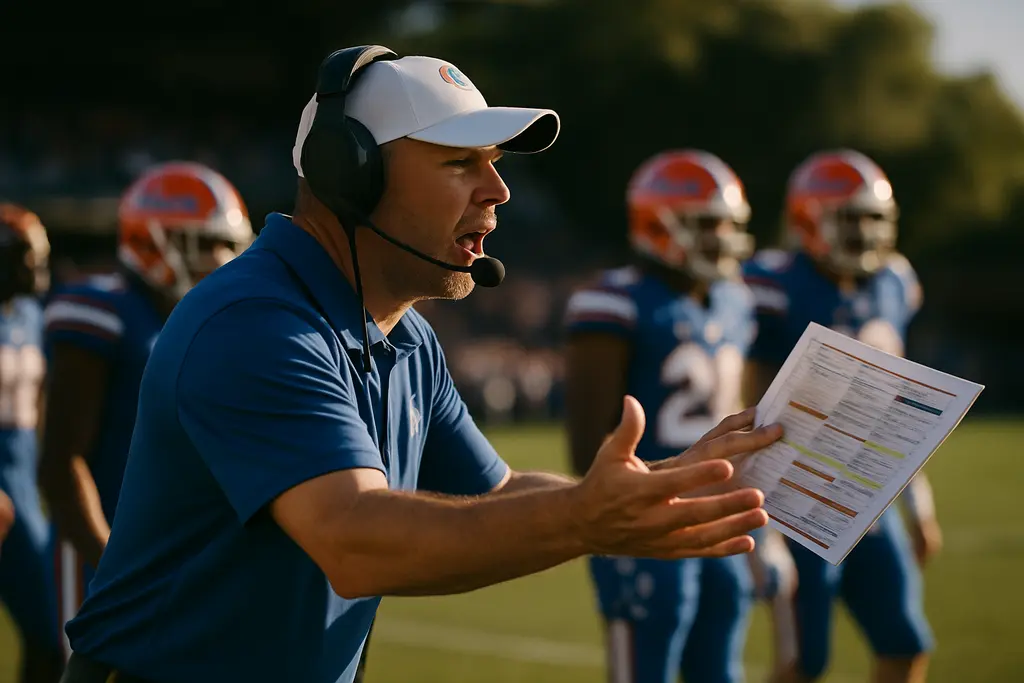
Gators Offensive Adjustments were the central question after Florida entered the October 10, 2026, South Carolina game needing a cleaner answer up front and a steadier run-pass rhythm. The Gators did not get enough of either in a 38-19 loss, a result that showed how quickly an offense can lose its preferred structure when the line of scrimmage and turnover margin work against it.
Florida had signs of the explosive offense that carried it earlier in the schedule, especially on the opening drive. Yet the larger game told a different story. The Gators finished with 120 rushing yards on 38 carries, while Aaron Philo completed 21 of 28 passes for 227 yards and a touchdown with two turnovers in the defeat, according to the official Florida recap. Those numbers point to the same issue: Florida found production in pieces, not in sustained command.
Gators Offensive Adjustments And The Opening Script
How Gators Offensive Adjustments Started Fast
Florida’s first possession looked like the kind of response the staff wanted after the previous week’s ground-game problems against Missouri. The Gators struck quickly on a three-play, 63-yard drive that ended with Bailey Stockton’s 59-yard touchdown catch. That sequence mattered because it created immediate space for the passing game and forced South Carolina to defend the field horizontally and vertically.
The problem was what happened after the script. An opening-drive explosive can hide early issues if the offense does not keep building first downs. Florida produced only two touchdowns in the 38-19 loss, and the game became more about missed drive extension than lack of isolated playmaking. For Gators Offensive Adjustments to hold up, the offense needed more than one early strike. It needed a repeatable answer on early downs, especially after South Carolina settled into the game.
Why The Second Quarter Mattered
The second quarter was where the offensive rhythm faded. Florida’s quick start did not turn into sustained field position pressure, and the offense struggled to stack productive series. That is where the South Carolina game connected to the Missouri setback: when Florida got off schedule, the offense had fewer clean chances to call the play-action and movement concepts that fit its best version.
Offensive coordinator Buster Faulkner had already acknowledged after Missouri that the offense had gotten off schedule. The South Carolina game showed why that phrase matters. Second-and-long and third-and-obvious passing situations reduce the value of run-pass balance. They also ask the offensive line to protect in spots where the defense can pressure without worrying as much about downhill run fits.
Line Play Set The Terms
Run Game Numbers Told The Story
Florida’s 120 rushing yards on 38 carries reflected a run game that kept trying to establish itself but did not consistently change the geometry of the defense. Faulkner had said before the game that the offense was built to run the ball, with passing coming on schedule when fronts and down-and-distance allowed it. Against South Carolina, that structure did not fully return.
Jadan Baugh’s line gives the clearest player-level view of the issue. He finished with 59 rushing yards and a touchdown on 15 carries, with most of that work coming after Duke Clark’s injury increased Baugh’s role. His second-half production showed effort and some late traction, but it did not change the broader game state. Florida needed more early-down efficiency before the game tilted toward catch-up football.
Protection Stress Showed Up
Head coach Jon Sumrall put the issue directly on the line of scrimmage after the loss, saying Florida did not win there in either the run game or passing game, as covered in his postgame comments. That is not only a run-blocking critique. It also explains why a quarterback can complete 75 percent of his passes and still not control the game.
Philo’s completion rate was strong, but the two turnovers changed the math. An interception and a fumble can erase the value of accurate short and intermediate passing because they cut off possessions before the offense can finish drives. In a game where Florida had limited room for error, those giveaways pushed momentum toward South Carolina and made every later series more urgent.
- Early-down run efficiency: Florida kept calling runs, but the average result did not consistently create manageable second and third downs.
- Pass protection strain: The line-of-scrimmage issue affected both timing throws and deeper-developing concepts.
- Turnover timing: Philo’s interception and fumble disrupted drives in a game where Florida needed longer possessions.
- Explosive-play dependence: The opening touchdown showed the offense still had burst, but not enough repeatable drive control.
Passing Efficiency Could Not Save The Drive Flow
Philo Was Accurate But Not Clean Enough
Philo’s 21-for-28 passing line is not the profile of an offense that could not throw the ball. The issue was that efficiency without ball security and drive finishing has a hard ceiling. Florida moved the ball through the air in stretches, but the turnovers became the plays that shaped the recap more than the completion percentage.
This is where the offensive adjustment conversation gets specific. If the run game is not producing enough leverage, the quarterback has to carry more third-down and pressure-down weight. That can work when protection holds and receivers separate on time. Against South Carolina, Florida had enough passing production to stay competitive in portions of the game, but not enough clean sequencing to turn completions into control.
Explosives Were Present But Not Stable
Sumrall also noted after the game that Florida had been exposed in a substantial way, with concern over the recent decline in explosive plays. The opening Stockton touchdown complicates that point in a useful way. Florida did hit a major explosive, but the offense did not keep producing them at a rate that offset its weaknesses elsewhere.
That distinction matters. One explosive play can change the scoreboard. A steady supply of explosives can change defensive calls. South Carolina did not have to defend Florida as if the next big play was always coming, especially once the Gators stopped stringing together productive early-down snaps. The result was an offense that had moments but not enough pressure over four quarters.
Skill Positions Shifted Under Pressure

Receivers Helped Cover The Absence
Florida played without wide receiver Vernell Brown III for a second straight week because of a knee injury, according to the research notes. Even with that absence, the receiver room produced. Stockton and Dallas Wilson combined for 201 receiving yards on 16 catches, giving Philo dependable targets and proving that the passing game was not short on individual answers.
That production is important because it keeps the loss from being reduced to one missing player. Florida had receivers make plays. The bigger issue was how those plays fit into the drive structure. Without stronger rushing efficiency and cleaner protection, receiver production became a counterpunch instead of the foundation of a full offensive plan.
Baugh’s Workload Became A Necessary Pivot
Baugh’s increased work after Clark’s injury created one of the few clear second-half offensive answers. His touchdown and late rushing production gave Florida a more direct style, but the timing limited its impact. Once the game had moved away from Florida’s preferred script, the run game needed to serve two jobs at once: regain balance and help chase points.
That is a hard spot for any offense. The Gators wanted to re-emphasize the run, but South Carolina’s control at the line made that difficult. A run-first identity requires more than volume. It requires displacement, clean entry points, and enough success to keep play-action credible. Florida had the intent, but the execution did not match it for long enough.
What Gators Offensive Adjustments Mean After South Carolina
The clearest read on Gators Offensive Adjustments after October 10, 2026, is that Florida identified the right pressure points but did not solve them during the game. Run-pass balance, line play, quarterback protection, and explosive-play creation were all part of the response plan. South Carolina still forced the Gators into a game shaped by stalled drives and missed chances.
For Florida fans, the concern is not that the offense lacked any answers. Stockton’s touchdown, Wilson’s receiving production, Philo’s accuracy, and Baugh’s second-half work all showed pieces that can function. The concern is that those pieces did not connect into a reliable game flow after the opening possession.
The South Carolina loss was not a case of one failed call or one missing adjustment. It was a layered offensive problem: the line did not control enough snaps, the run game did not stay ahead of the chains, turnovers cut into possession value, and explosives did not arrive often enough to cover those issues. Until those parts work together, Florida’s offense will remain capable of sharp moments without the sustained pressure needed to finish SEC games.