

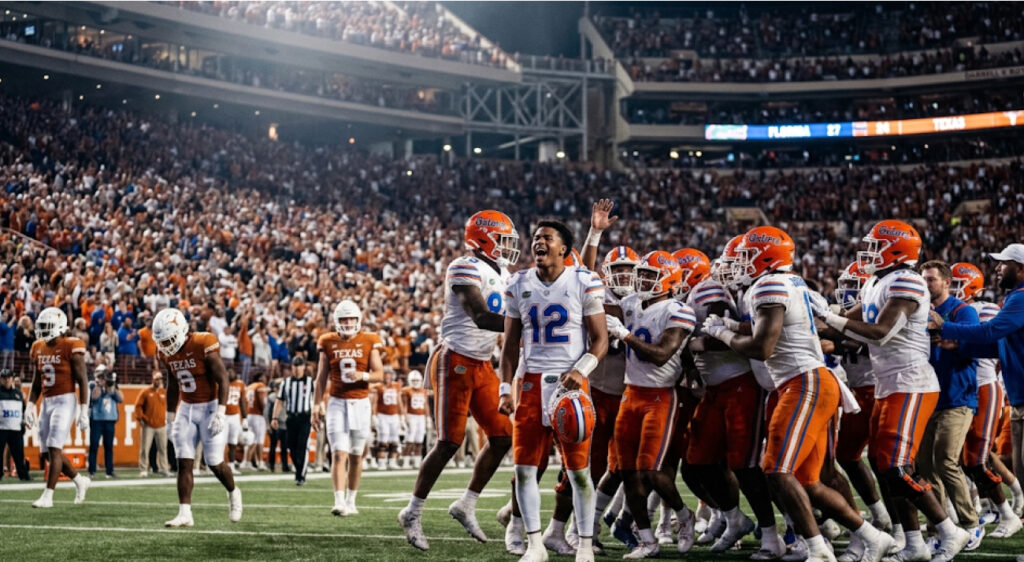
The Florida Gators delivered one of the most impressive turnarounds of their 2026 college football season on October 17, defeating the seventh-ranked Texas Longhorns 27–24 at Darrell K Royal–Texas Memorial Stadium in Austin. At the center of the upset was Tramell Jones Jr., a young quarterback making his first career start who helped Florida erase a 14-point deficit against a nationally ranked opponent. For fans following college football and evaluating sports betting options, questions such as Is Everygame a safe sportsbook? also highlight the importance of checking sportsbook security, licensing, and reputation before wagering on a game.
With more than 103,000 fans in attendance, Florida overcame early mistakes, controlled the second half and produced a defensive performance that transformed the game. The victory offered a significant boost for head coach Jon Sumrall after consecutive defeats against Missouri and South Carolina.
For the Gators, this was more than an unexpected road win. It was a demonstration of quarterback composure, offensive execution and defensive resilience at a critical point in the season.
Tramell Jones Jr. Steps Up in His First Career Start
Jones entered the starting lineup after quarterback Aaron Philo was sidelined by an injury sustained during Florida’s October 10 loss to South Carolina. Facing a difficult road environment against a Texas defense featuring several highly regarded players, Jones had little margin for error.
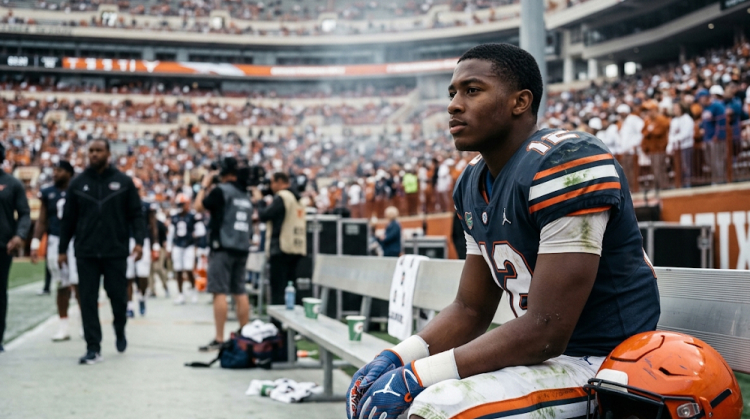
He responded by completing 22 of 35 passes for 155 yards and two touchdowns without throwing an interception. Both passing touchdowns went to tight end Lacota Dippre, whose contributions helped Florida regain momentum before halftime and tie the game early in the third quarter.
Jones also contributed on the ground, finishing with 41 net rushing yards on 10 attempts. His ability to extend plays and keep the offense moving helped Florida sustain possessions against a Texas team that had entered the matchup ranked among the nation’s stronger defenses.
The statistics did not represent a spectacular passing-yardage performance, but the context made the outing particularly significant. Jones protected the football, converted important third downs and delivered accurate throws when Florida needed to keep its comeback alive.
According to the official Florida Gators game report, Jones guided the offense through 24 consecutive unanswered points after the Gators fell behind 17–3.
That stretch established the foundation for Florida’s victory.
How Florida Overcame a 17–3 Deficit
Texas initially appeared to be in control. The Longhorns established an early lead through a 32-yard rushing touchdown by Raleek Brown and a 38-yard field goal by Gianni Spetic.
Florida responded with a 45-yard field goal from Patrick Durkin, but the Gators suffered another setback when Ryan Niblett returned a punt 63 yards for a Texas touchdown. The play pushed the Longhorns’ advantage to 17–3 and placed Florida in a difficult position.
Rather than abandon its game plan, Florida began to find rhythm through longer possessions and more disciplined execution.
Late in the second quarter, Jones connected with Dallas Wilson for a 17-yard gain on fourth-and-12. The conversion kept a drive alive and gave the Gators an opportunity to score before halftime.
Jones subsequently found Dippre for a seven-yard touchdown with 18 seconds remaining in the half. The score reduced Texas’ lead to 17–10 and gave Florida a chance to receive the second-half kickoff with momentum.
The Gators then delivered their most important offensive possession of the afternoon.
Florida opened the third quarter with a 15-play, 69-yard drive that consumed more than eight minutes. Jones converted five third downs during the possession before finding Dippre for an eight-yard touchdown.
The successful extra point tied the score at 17–17.
The drive illustrated how Florida could neutralize Texas’ defensive pressure through sustained possession, timely passing and an effective commitment to converting difficult downs.
The Defense Turns the Game Around
While Jones and the offense provided the comeback, Florida’s defense played an equally important role in the upset.
Texas quarterback Arch Manning finished with 14 completions on 20 attempts for 173 passing yards and one touchdown. Although his passing efficiency remained respectable, the Gators repeatedly disrupted his rhythm and prevented Texas from maintaining the offensive consistency needed to protect its lead.
Florida limited the Longhorns to 272 total yards, including 99 rushing yards. Texas also managed only two successful conversions on 10 third-down attempts.
The Gators recorded five sacks against Manning, putting consistent pressure on the quarterback and forcing Texas into difficult situations.
That defensive effort was particularly notable given Florida’s struggles in its previous two games. The Gators had allowed 45 points against Missouri on October 3 and 38 against South Carolina on October 10. Against Texas, the defense demonstrated a substantially stronger ability to control the line of scrimmage and disrupt the opponent’s offensive rhythm.
The decisive defensive moment came late in the fourth quarter.
After Texas cut Florida’s lead to 27–24, the Longhorns regained possession with an opportunity to complete their own comeback. However, Florida’s pass rush forced a fumble by Manning, and defensive back Kanye Clark recovered the ball with 1:58 remaining.
That recovery gave Florida the opportunity to protect its narrow advantage and run out the clock.
The sequence underscored the importance of defensive execution under pressure. Florida did not need to eliminate every Texas scoring opportunity; it needed to make one decisive stop when the outcome was on the line.
Jadan Baugh Provides the Ground Support
Florida’s running game helped prevent Texas from focusing exclusively on Jones and the passing attack.
Running back Jadan Baugh finished with 91 rushing yards on 25 carries and scored an important 11-yard touchdown in the fourth quarter. His score extended Florida’s lead to 27–17 with 6:22 remaining.
That touchdown proved crucial because Texas responded with a nine-yard touchdown pass from Manning to Cam Coleman, narrowing the margin to three points.
Baugh’s production also helped Florida control the clock and maintain offensive balance. The Gators finished with 158 rushing yards and 313 total yards, compared with Texas’ 99 rushing yards and 272 total yards.
Florida’s ability to generate yards on the ground made its offense more difficult to defend during the second half. It also helped the team sustain possessions at a time when protecting the ball and limiting Texas’ opportunities became essential.
The Numbers Behind Florida’s Upset
The official box score highlights the areas in which Florida gained the advantage.
| Statistic | Florida | Texas |
|---|---|---|
| Final score | 27 | 24 |
| Total yards | 313 | 272 |
| Passing yards | 155 | 173 |
| Rushing yards | 158 | 99 |
| First downs | 21 | 13 |
| Third-down conversions | 8 of 19 | 2 of 10 |
| Fourth-down conversions | 2 of 2 | 1 of 3 |
| Time of possession | 38:11 | 21:49 |
| Sacks recorded by defense | 5 | 1 |
The most striking difference was time of possession. Florida held the ball for 38 minutes and 11 seconds, more than 16 minutes longer than Texas.
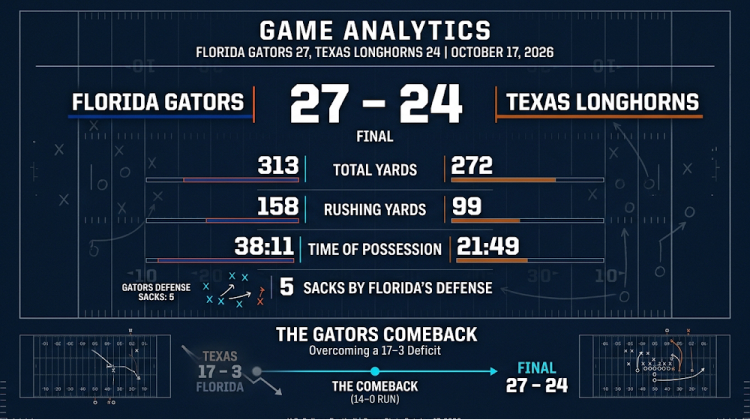
That advantage allowed the Gators to sustain drives, reduce the Longhorns’ offensive opportunities and keep the pressure on Texas’ defense.
Florida also converted both of its fourth-down attempts, including the crucial fourth-and-12 completion to Wilson before halftime. Those successful conversions helped turn promising possessions into scoring opportunities.
The numbers suggest that Florida’s victory was not simply the result of one unexpected play. The Gators won several important situational battles on both sides of the ball.
What the Win Means for Jon Sumrall and Florida Football
The victory was especially important for first-year Florida head coach Jon Sumrall.
After opening the season with four consecutive wins, Florida suffered consecutive defeats against Missouri and South Carolina. Those losses raised questions about the team’s consistency, defensive improvement and ability to compete against stronger SEC opponents.
Beating seventh-ranked Texas provided an immediate response.
The result also demonstrated that Florida could adjust to an unexpected quarterback change without abandoning its offensive identity. Jones’ first career start required the coaching staff to trust a young player in one of college football’s most challenging road environments.
The Gators’ success was built on complementary football: the offense sustained possessions, the running game produced a late touchdown, and the defense delivered the decisive stop.
Nevertheless, one victory does not resolve every concern. Florida must show that it can reproduce this level of execution against future SEC opponents, particularly after the inconsistency displayed in its two previous games.
For Jones, the performance represents a meaningful step in his development. His ability to protect the football and manage a comeback against a ranked opponent gives the coaching staff valuable evidence of what he can contribute when called upon.
Any longer-term implications for Florida’s quarterback depth chart will depend on Philo’s recovery, Jones’ continued development and the team’s subsequent performances.
Can Tramell Jones Jr. Build on His Breakthrough?
Jones’ performance against Texas offers a promising starting point, but the next stage of his development will require consistency.
His 155 passing yards and two touchdowns demonstrated that he could direct an effective offense without relying on high-volume passing production. His contributions as a runner also gave Florida another option when the pocket broke down or the defense covered the primary targets.
The challenge now is to build on those strengths while improving offensive efficiency and sustaining drives against defenses that will study the Texas game film.
Florida will also need continued production from Baugh, Dippre and its offensive line. The comeback showed how valuable it can be when the quarterback, running game and defense contribute to the same objective.
For Gators fans, the most encouraging aspect may be the team’s response to adversity. Florida faced a substantial deficit, played in front of a hostile crowd and entered the game following two disappointing performances. The team nevertheless maintained its composure and executed when the game was at its most demanding.
That resilience could prove valuable throughout the remainder of the SEC schedule.
Final Takeaway: A Statement Win for the Florida Gators
Florida’s 27–24 victory over No. 7 Texas on October 17, 2026, was one of the defining moments of the Gators’ season to that point.
Tramell Jones Jr. completed 22 of 35 passes for 155 yards and two touchdowns in his first career start. Jadan Baugh contributed 91 rushing yards and a touchdown, while the defense held Texas to 272 total yards and recorded five sacks against Arch Manning.
Most importantly, Florida turned a 17–3 deficit into a road victory through sustained offensive possessions, effective situational football and a decisive defensive play in the closing minutes.
For Jon Sumrall, the result offered a valuable response after consecutive losses. For Jones, it was an opportunity to demonstrate that he could handle responsibility against a nationally ranked opponent.
The next challenge is consistency. If Florida can maintain its defensive intensity, continue running the football effectively and develop reliable quarterback play, the win in Austin could become more than a memorable upset. It could serve as a turning point in the Gators’ 2026 campaign.
Source note: Game statistics and scoring details are based on official Florida Gators and Texas Longhorns athletics reports published October 17, 2026.