

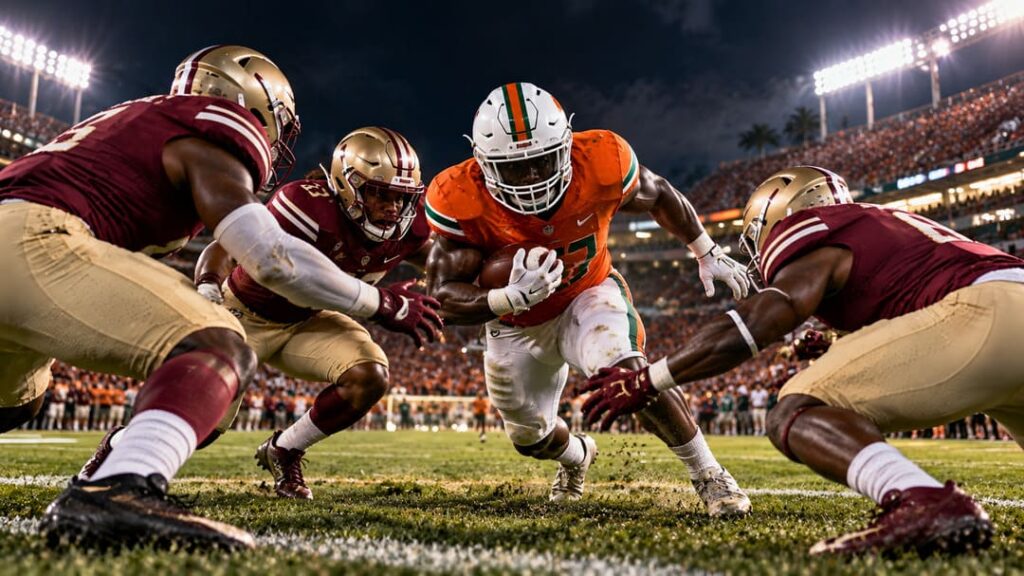
Florida State faces a difficult assignment against No. 4 Miami on Saturday, October 17, 2026, at Hard Rock Stadium. Kickoff is scheduled for 7 p.m. Eastern on ESPN. The Seminoles enter at 3-3 after a 44-20 loss to Louisville, while the undefeated Hurricanes are 5-0. For Florida State, the biggest question is whether its defense can prevent another game from being decided by explosive plays.
Pregame expectations may favor one team, but they cannot explain every matchup. Fans reviewing sports betting odds and analysis should remember that lines can change with new information and market activity. Florida State’s more immediate concern is measurable: Louisville rushed for 397 yards against the Seminoles, exposing problems that cannot be solved by simply generating more sacks.
Why Florida State’s Run Defense Needs Attention
Florida State led Louisville 14-0 in the first quarter before allowing 44 points and suffering its third defeat of the season.
The official Louisville game statistics reveal an especially troubling pattern. Louisville scored rushing touchdowns from 97, 68 and 44 yards, gaining 209 yards on those three plays alone.
Those runs accounted for approximately 53% of Louisville’s total rushing yardage.
Even removing those three gains, the Cardinals collected another 188 rushing yards on 40 attempts, averaging 4.7 yards per carry. This suggests Florida State’s problems extended beyond a few exceptional runs.
The Seminoles must improve defensive positioning, maintain their assignments and finish tackles before runners reach open space. Aggressive pursuit is valuable, but abandoning an assigned running lane can create the very openings an offense wants.
Against Miami, preventing those mistakes becomes especially important.
Miami’s Balanced Offense Creates a Different Challenge
Miami enters the rivalry game after defeating Clemson 41-13 on October 3.
In Miami’s official Clemson game recap, quarterback Darian Mensah completed 18 of 27 passes for 227 yards and a touchdown. Running back Mark Fletcher Jr. added two rushing touchdowns, while receiver Cooper Barkate finished with 98 receiving yards.
The Hurricanes demonstrated their ability to score quickly when Mensah connected with Barkate for a 61-yard touchdown on Miami’s first offensive play.
That combination creates a difficult defensive decision for Florida State. Committing additional defenders to stopping the run may leave fewer players available in pass coverage. Protecting against deep throws can make it harder to control the space near the line of scrimmage.
The solution is not automatically to become more aggressive. Florida State needs a disciplined approach that prevents ordinary gains from becoming game-changing touchdowns.
Ashton Daniels Must Keep Florida State’s Offense Moving
The Seminoles also need a more consistent offensive response.
Quarterback Ashton Daniels threw for 209 yards and two touchdowns against Louisville. Running back Ousmane Kromah contributed 88 rushing yards, but Florida State struggled to maintain its early momentum.
Miami’s defense presents another significant obstacle. The Hurricanes recorded six sacks against Clemson and limited the Tigers to 55 rushing yards.
Florida State cannot afford repeated long-yardage situations that allow Miami’s pass rush to attack without worrying as much about the run.
Short completions, effective early-down rushing plays and reliable third-down execution could help the Seminoles maintain possession. Daniels’ mobility remains valuable, but the offense should not depend on him escaping pressure to rescue every difficult play.
Florida State has already demonstrated it can produce touchdowns against conference opponents. The challenge is sustaining those drives when the defense adjusts.
What Could Decide FSU vs Miami 2026?
The rivalry’s history contains memorable close finishes and major defensive moments. Readers interested in that background can explore Florida rivalry history and classic matchups.
This year’s game, however, will be decided by current execution rather than historical results.
Three factors deserve particular attention: Florida State’s ability to prevent long runs, Miami’s effectiveness in pressuring Daniels, and the Seminoles’ ability to finish promising drives with touchdowns instead of empty possessions.
Miami’s official football schedule confirms the October 17 rivalry matchup as an Orange Out game at Hard Rock Stadium. The Hurricanes will be returning from an open week, while Florida State must respond to the Louisville defeat.
The most meaningful improvement for Florida State would not necessarily be another spectacular defensive play. It would be forcing opponents to earn their yards through sustained possessions rather than surrendering touchdowns through missed assignments.
For a Seminoles team looking to regain momentum, that is the standard worth watching against Miami.