

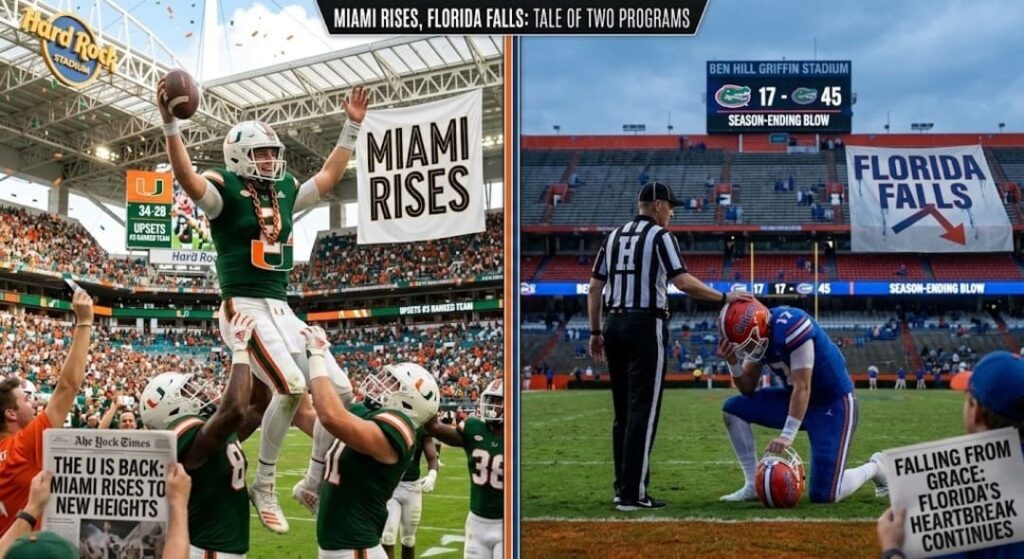
One week after Florida’s seven FBS programs produced a historic sweep, the statewide picture changed almost immediately. Miami walked into Clemson and looked every bit like a national contender. Florida was overwhelmed at Missouri. UCF watched a 17-point lead disappear. USF surrendered its unbeaten start at home.
That contrast is what makes Florida football Week 5 worth examining beyond the final scores. The perfect statewide Saturday established that Florida had unusual depth. This weekend supplied the harder information: which teams can maintain their identity when the opponent, venue and game script stop cooperating?
For now, Miami has created separation.
The Betting Market Helps Explain How Different These Losses Were
Four results can all count as wins or losses in the standings and still tell completely different stories.
Pregame markets expected Miami to control Clemson, expected Florida and USF to win, and treated UCF as a sizable road underdog. What happened afterward is revealing.
| Florida Team | Pregame Spread | Final Result | Market Result | What It Revealed |
|---|---|---|---|---|
| Miami | -14 at Clemson | Won 41-13 | Covered | Contender-level road performance |
| Florida | -5.5 at Missouri | Lost 45-17 | Lost outright | Run-first identity was dismantled |
| UCF | +11.5 at Houston | Lost 27-17 | Covered | Competitive, but unable to finish |
| USF | -6 at Temple | Lost 17-13 | Lost outright | Offense lacked enough finishing power |
Those numbers should not become the analysis by themselves. They help frame expectations.
Miami did what a top-five team was priced to do and then exceeded it. Florida and USF did something more damaging: both lost outright as favorites. UCF’s collapse was frustrating, but the Knights were never expected to control Houston for four quarters in the first place.
That distinction matters when deciding which result should actually change how we view a team.
Miami Passed the Test That September Could Not Provide
Miami had already looked dominant. The question was whether that dominance would travel into Clemson.
It did.
The Hurricanes won 41-13, improved to 5-0 and remained No. 4 in the latest AP poll. Darian Mensah completed 18 of 27 passes for 227 yards and a touchdown without an interception. Mark Fletcher Jr. ran for 77 yards and two scores, while Miami’s defense produced six sacks and nine tackles for loss.
The 41-13 road win mattered because Miami never needed chaos to create it.
Cooper Barkate’s 61-yard touchdown reception gave the Hurricanes an immediate explosive play. Mensah later scored on a 34-yard scramble. A 14-play, 83-yard touchdown drive consumed nearly eight minutes in the third quarter.
Miami could strike quickly and then suffocate the game slowly.
That is contender behavior.
The defense added the punctuation. JJ Dunnigan returned a late interception 39 yards for a touchdown, and Clemson finished with two turnovers while Miami committed none.
September showed that Mario Cristobal’s team had talent.
Clemson showed that the structure travels.
That is the difference between an unbeaten team and a team that begins to look built for December.
Missouri Found the Problem Florida Had Been Able to Hide
Florida’s 45-17 loss was more significant than simply falling from No. 8 to No. 16.
Missouri removed the foundation of the Gators’ offense.
One week earlier, Florida rushed for 302 yards while beating Ole Miss 52-28. Jadan Baugh controlled that game with 142 yards and three touchdowns.
At Missouri?
Baugh finished with 13 yards on 12 carries.
Florida managed 42 rushing yards as a team. Missouri produced 220.
The Missouri game numbers show how completely the matchup reversed Florida’s preferred formula: the Tigers outgained the Gators 560-325, Austin Simmons threw for 340 yards and Jamal Roberts ran for 211 yards and three touchdowns.
This is the first real schematic warning for Jon Sumrall’s offense.
Florida had been at its best when Baugh created manageable downs and Aaron Philo could operate without carrying the entire offense. Missouri loaded the game in the opposite direction. The Gators could not establish the run, Philo averaged fewer than six yards per passing attempt and Florida spent the second half chasing.
Missouri created a blueprint.
Future opponents do not automatically possess the personnel to copy it. But the assignment is obvious now: squeeze Baugh, force Florida behind schedule and make Philo win repeated obvious passing situations.
Florida’s remaining SEC schedule means that problem has to be solved quickly. South Carolina comes next, followed by Texas, Georgia and Oklahoma in a brutal October-November stretch.
The Ole Miss win remains meaningful.
It just no longer answers every question.
UCF Proved It Can Compete, Then Showed Why That Is Not Enough
For roughly two and a half quarters, UCF’s trip to Houston looked like another step forward.
The Knights led 17-0.
Then the game flipped completely.
Houston scored the final 27 points, including 13 in the fourth quarter, and won 27-17. Keyone Jenkins finished 23-of-35 for 253 yards, one touchdown and one interception after his nearly perfect 19-of-20 performance against TCU.
The problem was not that Jenkins suddenly became ineffective.
It was that UCF could not stop the game from changing.
After taking the 17-point lead, the Knights generated only 35 yards and one first down over the final 24 minutes. Houston quarterback Conner Weigman scored three rushing touchdowns as the Cougars slowly took control.
There is a developmental distinction here.
UCF is good enough to put a ranked road opponent in serious trouble. It is not yet consistent enough to close the door once momentum turns.
That is progress without proof.
At 3-2, Scott Frost’s team does not need a dramatic philosophical reset. It needs an answer for the stretches when its first plan stops working.
USF’s First Loss Exposed a Smaller but Familiar Problem
USF’s 17-13 loss to Temple was nowhere near as destructive as Florida’s defeat.
The Bulls actually outgained Temple 319-274 and took a 13-10 lead in the fourth quarter.
Then Temple drove 96 yards for the winning touchdown.
USF fell to 4-1 after entering the weekend as the American’s only unbeaten team. Michael Van Buren Jr. threw for 205 yards without an interception, but the Bulls repeatedly failed to turn possession into enough points.
That sounds familiar because USF had already shown signs of this problem at Bowling Green.
The Bulls won that game 14-6 after being shut out through three quarters. Their defense and running game gave the offense enough time to recover.
Temple did not.
Brian Hartline’s first loss therefore should not create panic. It should create urgency around offensive consistency.
A team can survive one ugly quarter.
It becomes much harder to build a conference run when whole games become offensive survival exercises.
Florida Football Week 5 Created a Clearer State Hierarchy
The September 26 sweep was real. It showed something important about the depth of football across the state.
It never meant the programs were equal.
Florida football Week 5 made that distinction obvious.
Miami has the cleanest case because its strengths survived the environment change. The Hurricanes went to Clemson, protected the football, pressured the quarterback, ran effectively and controlled the game in multiple ways.
Florida learned that its offensive identity can be disrupted. UCF learned that creating a big lead and finishing a ranked road game are separate skills. USF learned that defensive resilience cannot permanently compensate for inconsistent scoring.
October now begins with a much clearer hierarchy.
Miami is not merely the best-performing Florida team because it remains unbeaten.
The Hurricanes are the one program that faced the weekend’s pressure test and came out looking more convincing than they did going in.