

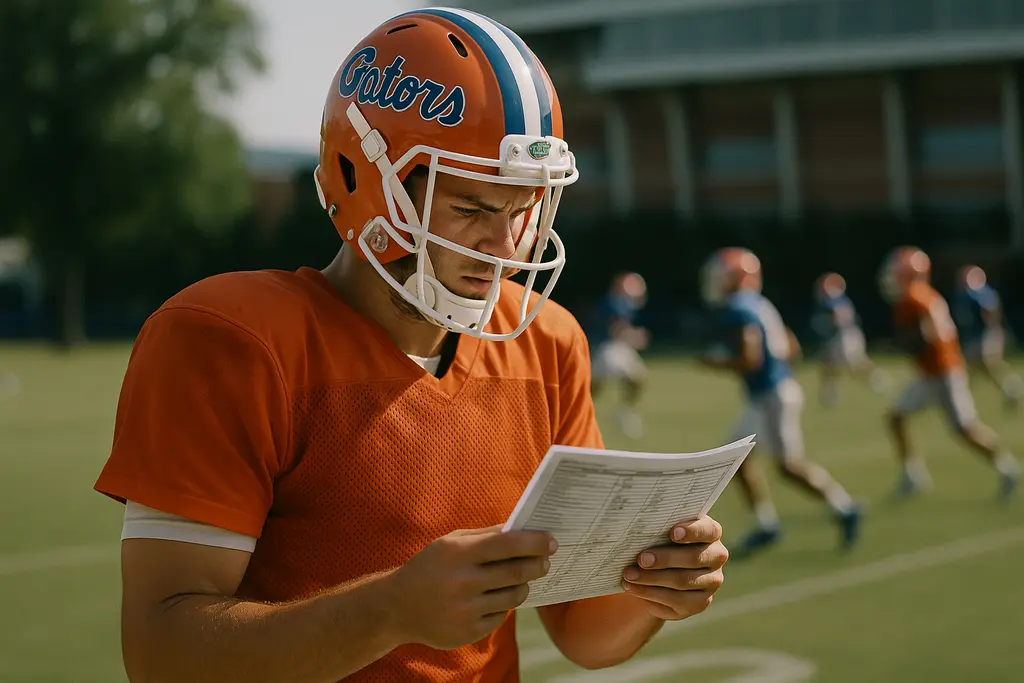
The Gators QB Battle between Georgia Tech transfer Aaron Philo and redshirt freshman Tramell Jones Jr. is more than a preseason depth chart item. It will affect how Florida builds its weekly call sheet, how much of the offense can be carried into a game, and which situations the staff is willing to attack. Florida’s official site has described the finish line for the quarterback race as far away, with Philo and Jones at the center of the competition Florida’s QB race.
The key point for game-day strategy is not just who wins the job. It is how the staff gets there. A race that remains open through spring work can force coaches to keep two versions of the offense ready. That can be useful if both quarterbacks handle the base plan, but it can also slow down the push toward a narrower identity. Florida has to balance competition with clarity.
How The Gators QB Battle Changes The Call Sheet
Gators QB Battle And First-Drive Scripts
The first drive of a game often shows what a staff trusts most. If Florida enters the season without a long-established starter, the opening script may lean toward answers that work for either quarterback: quick throws, defined reads, play-action concepts, screens, and run looks that do not ask the quarterback to solve too much after the snap. That does not mean the offense becomes conservative. It means the first 10 to 15 calls may be built to gather clean information.
Those early calls can tell the sideline how the quarterback is seeing coverage, how the offensive line is handling protection communication, and whether the defense is willing to crowd the box. A quarterback competition changes that process because the staff is not only calling plays to move the ball. It is also measuring which player can keep the offense on schedule when the defense changes the picture.
Why The Middle Eight Can Separate The Race
The end of the first half and the start of the third quarter are where a quarterback’s control of the offense becomes most visible. Florida’s staff will want a quarterback who can handle clock, field position and risk without turning a possession into a scramble drill. The research notes from the Orange & Blue Game say both Philo and Jones threw touchdown passes on April 11, 2026. That matters because neither candidate let the public evaluation tilt sharply in the other direction.
The more useful question is what happens between scoring throws. Does the quarterback check the ball down on second-and-long? Does he avoid a sack that changes field-goal range? Does he keep tempo clean after a penalty? Those plays rarely frame the highlight, but they shape whether a coordinator can call aggressively on the next series.
Practice Reps, Tempo And Protection Calls
Even Reps Can Help Evaluation And Delay Timing
A fluid depth chart can help a staff make a fair evaluation. It can also affect offensive timing. Receivers need repeated work with the same release points, ball placement and cadence. Offensive linemen need to hear the same quarterback set protections and adjust to pressure looks. If two quarterbacks are sharing work deep into camp, Florida has to make sure the competition does not reduce the precision needed for SEC Saturdays.
That is why the Gators QB Battle reaches beyond the quarterback room. A split-rep structure can keep both players sharp, but the offense still has to settle on the route depths, protection tags and tempo packages that will show up on game day. If the staff carries too much into a week, the offense risks being broad but not sharp. If it trims too early, it may miss a chance to identify which quarterback handles pressure best.
Tempo Depends On Command, Not Just Arm Talent
Tempo is one of the clearest strategy points tied to this race. A staff can play fast only if the quarterback can get the call, align the formation, communicate the protection and snap the ball without confusion. If Florida’s coaches trust one quarterback to operate at speed, that can change the rhythm of a drive. It can limit defensive substitutions and keep the offense out of third-and-long.
If that trust is not there yet, the staff may choose a slower pace that gives the quarterback cleaner pre-snap information. That is not a weakness by itself. It can be the right call for an offense still sorting out its leader. The strategic choice is about matching pace to command. For a related breakdown of how this race can affect fourth-down and tempo decisions, see our analysis of how the Gators QB Battle shapes game-day planning.
Spring Game Signal Versus SEC Reality
Touchdown Throws Are Data Points, Not Final Answers
Spring-game touchdowns create attention, but staff decisions usually depend on a wider sample. A quarterback can throw a clean touchdown in a controlled setting and still need to prove he can handle a third-down pressure package. The spring-game note that both quarterbacks produced touchdown passes is useful because it confirms the race stayed competitive. It does not answer who is best equipped to manage a full SEC game plan.
Florida’s coaches will be watching how each quarterback responds to the hidden parts of the position. That includes protection checks, throwaways, pre-snap motion, and whether a quarterback can get the offense into the right play without burning timeouts. Those details shape field position and momentum. One missed blitz pickup can turn a promising drive into a punt. One correct check can turn a bad look into a manageable gain.
The Turning Point May Be Situational Trust
The turning point in this competition may not be a single deep throw. It may be the first time the staff clearly trusts one quarterback more in a two-minute drill, backed-up possession or red-zone sequence. Those are the areas where a game plan becomes specific. If a quarterback earns trust on third-and-medium, the staff can call concepts that attack the sticks. If he earns trust near the goal line, the play sheet can include more answers than a straight run or a low-risk fade.
Sports Illustrated’s spring-camp report on Tramell Jones Jr. framed his evaluation as part of Florida’s broader quarterback decision SI’s spring-camp report. That is the right frame. This is not only a comparison of arms. It is a comparison of how each player lets the staff call the game.
How Staff Choice Affects The Rest Of The Offense
Receivers Need A Defined Rhythm
Quarterback competitions can sharpen a team, but receivers eventually need a stable rhythm. Ball placement, timing on option routes and trust on contested throws are built through repetition. If Florida wants its passing game to be efficient on early downs, the eventual starter must be able to create predictable timing for the route group. The staff’s choice can influence which routes become weekly staples.
For example, a quarterback who consistently gets the ball out on time can support a call sheet with more rhythm throws. A quarterback who is better at extending plays can change how receivers are coached on scramble rules. The research does not establish those specific traits for Philo or Jones, so the safest analysis is conditional: the winner’s strengths will narrow the menu, and that narrowing is what makes a Saturday plan more useful.
Protection And Run Game Fit Are Linked
The offensive line is affected by the quarterback decision as much as the receiver room. Protection calls depend on cadence, communication and pocket location. The run game can also be shaped by how a defense treats the quarterback. If a defense believes the quarterback is a threat to punish aggressive looks through the air, it may hesitate to overload run fits. If the defense is comfortable forcing long-yardage throws, Florida may face more pressure packages.
That connection is why the quarterback choice can change game-day risk. The staff may be more willing to go for it on fourth-and-short if it trusts the quarterback to handle a run-pass answer. It may also be more willing to take a shot after a sudden-change turnover if the starter has shown he can protect the ball on the next snap.
Why The Gators QB Battle Matters On Saturdays
What Florida Fans Should Track
The Gators QB Battle is important because it will show up in the small calls that decide field position and momentum. Watch who gets trusted in third-down periods, who handles the two-minute work, and who keeps the offense from wasting plays after penalties. Those situations will say more than a single spring throw.
- First-drive calls: Do coaches give the quarterback layered reads, or do they build the series around fast answers?
- Third-down choices: Does the play call attack the marker, or does it protect against a mistake?
- Red-zone plan: Does Florida trust the quarterback to throw between defenders in tight space?
- Tempo usage: Does the offense speed up after a first down, or does the sideline slow the operation?
Florida does not need the race to be decided by noise. It needs the race to produce a quarterback the staff can call for in pressure moments. If Philo or Jones separates by handling those situations, the offensive plan becomes cleaner. That is where this competition will shape game day: not in the label of starter, but in the calls Florida is willing to make when a drive can swing the game.