
The Florida State football 2026 season does not need another August championship. Seminoles fans have seen enough offseason optimism turn into October arithmetic. After a 5-7 season that began with a win over Alabama and ended without a bowl, the question is not whether Mike Norvell’s roster can look dangerous in shorts. It is whether Florida State can become dependable when games become uncomfortable.
The betting market will turn September into a referendum after every Saturday. Fans comparing futures or early prices should understand the operator they use; the Heritage Sports rating and review notes that Heritage operates offshore rather than under U.S. state regulation. More important, the 2025 Alabama upset proved one grand afternoon cannot carry a season.
| Fall-camp question | Encouraging signal | Proof required |
|---|---|---|
| Quarterback control | Daniels is managing the full menu | Efficient third downs and few giveaways |
| Backfield order | Three credible options | Defined roles without killing rhythm |
| Robinson’s impact | Proven explosive production | Targets when defenses bracket him |
| Defensive growth | More speed and communication | Disruption without coverage busts |
| September readiness | Manageable opener, rapid escalation | An identity that travels |
Florida State Football 2026: Has Ashton Daniels Taken Control?
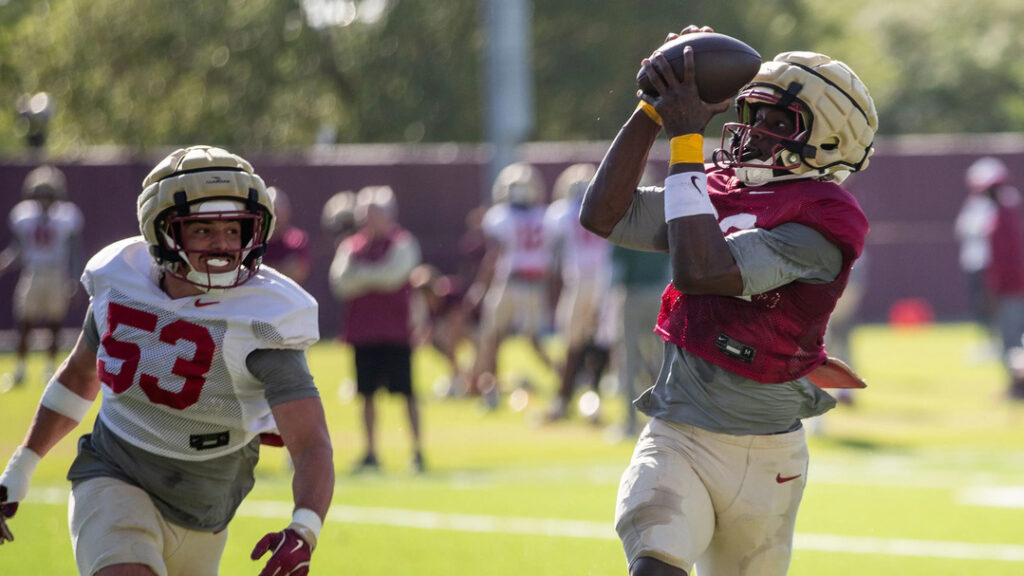
That is why the first scrimmage matters without becoming prophecy. Ashton Daniels showed command, the defense played with speed, and several skill players flashed. But the FSU schedule outlook is blunt: New Mexico State offers an opening statement, SMU demands answers, and Alabama will expose anything Florida State pretended to fix.
Daniels does not have to be a superhero. Florida State should resist asking him to become one. Norvell praised his confidence, decision-making and third-down ball placement after the first scrimmage, details that matter more than a viral deep throw. Daniels has played enough college football to recognize pressure; now he must beat it without turning every broken pocket into backyard football.
The concern sits in front of him. A rebuilt offensive line can make a veteran quarterback look new quickly. Daniels’ mobility helps, but mobility is not a blocking scheme. His camp victory will be getting Florida State into the correct protection, taking the available throw and keeping the offense on schedule. Malachi Marshall missing the first scrimmage also makes the backup competition uncomfortably relevant.
How Should Florida State Divide the Running-Back Carries?
Ousmane Kromah, Tre Wisner and Samuel Singleton Jr. give Florida State options, but depth becomes a compliment only when a staff knows how to use it. Kromah has breakout appeal, Wisner supplies experience, and Singleton can punish defenses that lose leverage. The temptation will be to rotate constantly because everybody deserves touches.
That can become football socialism: fair in theory, awkward on third-and-two.
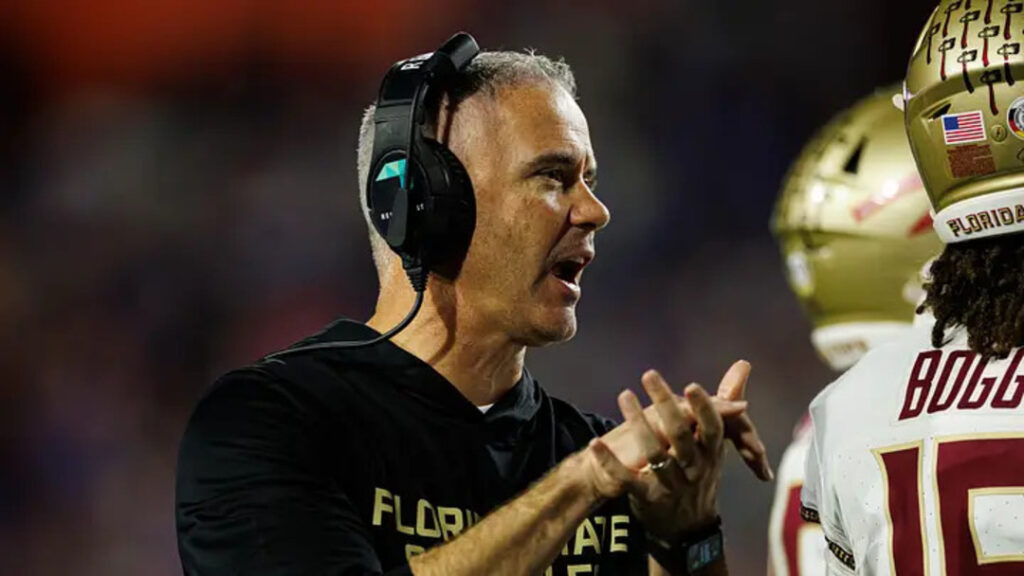
Norvell should build a hierarchy without building a monopoly. Let the hot runner stay hot, identify the best pass protector, and reserve packages for specific skills. A three-back rotation can protect legs and create matchup problems. A three-back guessing game can prevent any runner—and the offensive line—from finding rhythm.
Can Duce Robinson Become More Than the Best Player?
Robinson enters 2026 with evidence, not camp mythology. He caught 56 passes for 1,081 yards and six touchdowns in 2025, becoming Florida State’s first 1,000-yard receiver since 2019, and was named a second-team Sporting News preseason All-American. Those honors are deserved. They also guarantee defensive coordinators will treat him as the first problem on every call sheet. His preseason recognition confirms the expectation.
Florida State must move him around, manufacture clean releases and punish bracket coverage elsewhere. A star receiver is valuable. A star who changes the geometry of the entire offense is season-altering. Daniels should not force Robinson the ball; he should make defenses regret every extra defender assigned to him.
Is Tony White’s Defense Ready for a Year-Two Jump?
This optimism has structural support. White’s 3-3-5 is built on disguise, speed and pressure from changing angles. In year two, players should react rather than translate. Norvell highlighted that speed after the scrimmage and singled out Ashlynd Barker at rover, the position that can turn White’s scheme from chalkboard art into weekly discomfort.
Barker’s 48 tackles, five tackles for loss and 3.5 sacks in 2025 show why the role fits. Yet the defense cannot live on havoc alone. The Seminoles need cleaner tackling, fewer explosive concessions and better answers after offenses identify pressure. The site’s Florida defense grades offer the right lens: disruption matters when it ends drives, not when it decorates a losing box score.
What Must Florida State Learn Before Alabama?
The official 2026 schedule gives Florida State an extended break between SMU and Alabama. That helps, but it is not magical. By then, the Seminoles must know whether their line can protect passing downs, whether Daniels can avoid reckless mistakes, and whether the defense can tackle in space.
Florida State football 2026 will be defined by repeatability: stable protection, efficient quarterback play, purposeful touches for Robinson, and a defense that creates chaos without becoming chaotic. If those answers arrive, the Seminoles can reenter the ACC conversation. If they do not, September will reveal that Florida State spent another August admiring questions it never solved. That standard matters.