
Florida has already won the easiest part of a coaching change: the offseason mood swing.
Jon Sumrall arrived with credibility, urgency and direct language that plays well in Gainesville after a 4-8 season. He retained important players, rebuilt much of the roster and gave a frustrated fan base permission to feel hopeful again. Now he has to turn that energy into third-down conversions against SEC defenses.
Later, the schedule brings Ole Miss, Missouri, Texas, Georgia, Oklahoma and Florida State. The Georgia game in Atlanta will again carry major regional attention; readers following the surrounding wagering market can consult this Georgia sports betting overview. The football point is simpler: Florida’s schedule will not patiently wait for a young quarterback to become comfortable.
Florida does not need a camp celebrity. It needs a quarterback who can protect the football, manage pressure and make enough aggressive throws to stop defenses from smothering Jadan Baugh and the running game.
The Florida Gators quarterback battle is Sumrall’s first major competitive decision. Recruiting energy can create momentum. Choosing the wrong quarterback or choosing the right one too late can erase it quickly.
This Is Bigger Than Picking a Starter
Quarterback competitions attract attention because they are easy to understand. One player wins, one player loses, and every practice rep becomes evidence for somebody’s preferred conclusion.
Florida’s situation is more complicated. Sumrall is not selecting a quarterback for a stable roster with an established line and years of system continuity. The Gators added 24 freshmen and 34 transfers, meaning more than half of the scholarship roster is new. This is a team-building project occurring at SEC speed.
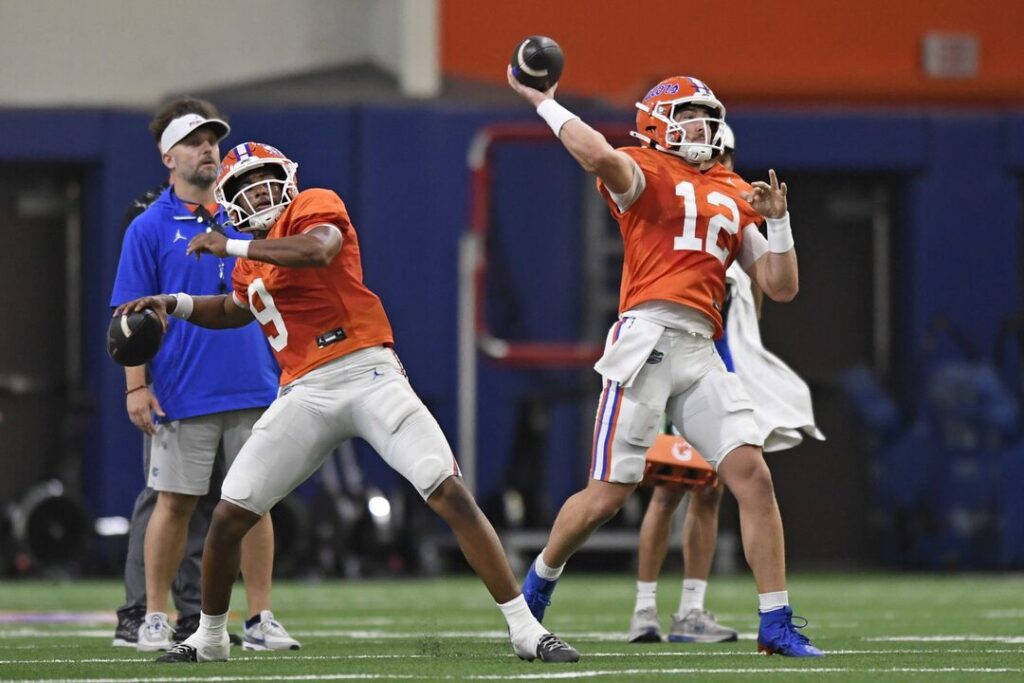
Philo represents familiarity. He transferred from Georgia Tech after working with Faulkner, and Sumrall has acknowledged that his coordinator’s confidence influenced the decision to bring him to Gainesville. Jones represents continuity with Florida, developmental upside and a different kind of ownership over the transition.
Neither is a proven SEC starter. That is not an insult; it is the central fact of the competition.
Philo completed 59 of 102 passes for 938 yards, two touchdowns and three interceptions in limited Georgia Tech action. Jones appeared in two Florida games in 2025, completing 21 of 35 passes for 191 yards and two touchdowns before retaining his redshirt. Their resumes offer clues, but neither removes uncertainty.
The staff must determine which player best connects the operation: protection calls, run checks, tempo, receiver communication, third-down decisions and emotional control after a bad series.
The starter must make a new offense feel older than it is.
Why Aaron Philo Has the Cleanest Early Advantage
Philo’s advantage is not that Faulkner owes him the job. Familiarity is not a lifetime appointment, and the SEC exposes quarterbacks who play because a coach feels comfortable rather than because the offense functions.
Still, prior knowledge matters.
Philo understands how Faulkner wants quarterbacks to see the field, sequence reads and respond to mistakes. He knows at least part of the terminology and teaching style. That can reduce the mental burden of installing an offense while dozens of new teammates learn new roles.
The spring game showed both the value and limitation of Philo’s case. He completed 21 of 28 passes for 193 yards and two touchdowns, but also threw two interceptions. More important than the line was his response: he kept attacking and produced scoring throws after the mistakes. The official spring-game breakdown illustrated why Faulkner trusts his ability to recover rather than retreat.
That resilience matters because a first-year offense will have ugly possessions. Protections will break. A receiver will make the wrong adjustment. The quarterback cannot turn every breakdown into a four-play emotional crisis.
Philo’s strongest argument is that he may operate the offense sooner. His challenge is proving familiarity creates production rather than merely comfort.
He must also show that the spring turnovers were part of aggressive learning, not a recurring flaw. Against FAU or Campbell, a giveaway may create irritation. At Auburn, it can create a two-score deficit.
Knowing the offense is the starting point. Commanding it is the standard.
What Jones Must Prove in the Florida Gators Quarterback Battle
Jones has the more emotionally satisfying story for part of the fan base. He stayed, developed and now has a chance to connect Florida’s previous roster to Sumrall’s new era.
College football is not obligated to reward narrative symmetry.
The harder work begins when preseason practice opens August 5. For readers following our Florida Gators coverage, the central camp issue is not simply whether Aaron Philo or Tramell Jones Jr. receives the first snap. It is whether Sumrall and offensive coordinator Buster Faulkner can identify the quarterback who gives a heavily reconstructed team its clearest path to functional offense.
Jones must win the job with evidence. His spring-game performance supplied plenty: 13 completions on 17 attempts, 210 yards and two touchdowns, including scoring throws of 38 and 75 yards. He recovered from a slow opening and became more comfortable as the afternoon progressed.
The arm talent is easy to see. The harder question is whether he can consistently produce the correct answer before the snap and on the first hitch after it.
Explosive throws win offseason arguments. Quarterbacks win SEC games by avoiding the negative plays that destroy drives. Can Jones identify pressure, set the protection and take a six-yard completion instead of waiting for a 30-yard possibility?
Florida needs his vertical ability. Brown and the receiving group become more dangerous when defenses fear isolated coverage. But aggression without down-to-down control becomes random offense, and random offense is a cruel way to live on the road in the SEC.
| Evaluation Area | Aaron Philo | Tramell Jones Jr. | What Florida Must Learn |
|---|---|---|---|
| System familiarity | Prior experience with Faulkner | Learning a new structure | Who operates fastest without mental errors? |
| College experience | More passing attempts | Limited Florida game action | Whose experience translates under pressure? |
| Spring-game signal | Rebounded after two interceptions | Produced explosive touchdowns | Which traits repeat throughout camp? |
| Best early argument | Comfort and resilience | Arm talent and upside | Which strength helps the full offense most? |
| Main concern | Turnover risk | Snap-to-snap consistency | Who avoids drive-killing mistakes? |
The race should not be decided by who produces the loudest highlight on August 15. Jones must prove his best plays are attached to a dependable quarterbacking process. If he does, the offense’s ceiling may rise with him.
The Offensive Line and Two-Quarterback Temptation
Quarterbacks do not operate in laboratory conditions. They operate behind five linemen whose collective competence determines whether the playbook remains available.
Sumrall said during spring that the tackle decisions concerned him as much as the quarterback choice. At SEC Media Days, he added that the line’s inherited strength level did not initially meet his standard, while noting visible offseason progress.
If protection remains inconsistent, Florida may favor the quarterback who identifies pressure fastest, releases the ball on time and avoids turning a protection failure into a catastrophic play. The best deep passer is not useful if the pocket never lasts long enough for deeper concepts to develop.
The staff must grade the cause, not merely the result. A sack may belong to the tackle, the back, the center’s call or the quarterback holding the ball. A checkdown may be mature processing rather than timid play.
Florida has proven help elsewhere. Baugh rushed for 1,170 yards and eight touchdowns in 2025, while Brown led the team with 40 receptions and 512 yards as a true freshman. Both earned preseason All-SEC recognition, giving the eventual starter legitimate players around whom the offense can be organized.
Florida needs efficiency before heroics.
The close race will create talk of using both quarterbacks. Sumrall has survived that arrangement before. His first Troy team rotated quarterbacks amid injuries and inconsistent play and still reached the conference championship game, although he has said he does not enjoy constant shuffling.
A defined package for the backup can work. An indecisive rotation usually cannot. Quarterbacks need rhythm, linemen need cadence consistency and receivers need to understand how each passer anticipates breaks.
Florida should choose a starter, define the standard and retain the flexibility to use the other player in a specific role. A package is a plan. A weekly referendum is not.
The August Scrimmages Must Build Toward Auburn
Florida’s first preseason practice is reportedly scheduled for August 5, with scrimmages on August 15 and August 22. Those dates should create checkpoints, not election nights. The staff must evaluate the full body of work rather than allowing one tipped interception or busted-coverage touchdown to determine the season. The reported camp timetable provides the framework.
By the first scrimmage, Florida should know which quarterback processes the offense most consistently.
By the second, the staff should be testing game situations: backed up near the goal line, two-minute offense, third-and-medium, red-zone decisions and protection adjustments against simulated pressure.
The season opens against Florida Atlantic on September 5 and continues with Campbell on September 12. Those games matter, but they also prepare Florida for its first credibility test: SEC play opens at Auburn on September 19 at 7 p.m. on ESPN.
Jordan-Hare Stadium is not the place to discover that the quarterback and center disagree on protection language. Auburn will have its own first-year coach in Alex Golesh and its own pressure, but Florida cannot count on the opponent’s transition to make the environment polite.
The winner does not need to look perfect against FAU and Campbell. He needs to make the offense coherent enough that Florida arrives at Auburn with answers rather than theories.
The September deadline is real, even if Sumrall declines to announce one publicly.
When does Florida begin SEC play?
Florida opens SEC competition at Auburn on September 19 at 7 p.m. Eastern. The Gators first host Florida Atlantic on September 5 and Campbell on September 12.
The most important outcome of camp is not that Philo defeats Jones or Jones defeats Philo. It is that Sumrall proves he can make a difficult decision for the right football reasons.
Choose the quarterback who organizes the offense, gives the line clear answers and turns Baugh into the center of a sustainable attack. Then support him.
The fan base will debate every incompletion because that is what fan bases do. Sumrall cannot coach the debate. His job is to recognize what this rebuilt roster needs before the SEC exposes what it lacks.
The Florida Gators quarterback battle will define his first camp because it is the first time the new coach must convert optimism into a consequence. The decision will not determine every result of 2026, but it will reveal whether Florida’s new era is being built around a coherent football plan or another August promise.
That is the standard readers should carry into every piece of Gators season analysis: not who won the press conference, but whether the program made the decision that gives the entire roster its best chance to win.
That makes camp less about winning isolated drills and more about building trust. Florida’s quarterback must communicate with a reshaped line, establish timing with receivers and recognize when Baugh should become the answer instead of forcing a throw. Those details rarely dominate August headlines, but they decide whether an offense survives road games. Sumrall’s choice must reflect who can make eleven players look connected, not who flashes the strongest arm.
The pressure begins long before the first snap at Auburn.
Frequently Asked Questions:
Who is competing to start at quarterback for Florida in 2026?
Georgia Tech transfer Aaron Philo and returning Florida quarterback Tramell Jones Jr. are the leading candidates. Sumrall carried the competition through spring practice and said in July that both remained viable starters entering preseason camp.
Does Philo have an advantage because he knows Faulkner’s offense?
Yes, but it is an initial advantage rather than proof that he should start. Familiarity can accelerate installation and decision-making, but Philo must still protect the football and produce better execution.
Could Florida use both quarterbacks?
It is possible. Sumrall has previously managed a two-quarterback season, but a defined situational role is different from an unresolved rotation. Florida would risk disrupting rhythm if every game became another audition.