
Let’s be honest, the college football playoff committee needed a new script. The old one—where blue-blood programs waltz to the title—was getting stale. Then, The U decided to rewrite it entirely.
Their 24-14 win over No. 2 Ohio State wasn’t just an upset; it was a statement delivered with a sledgehammer. Now, the dust settles in the Arizona desert for a Fiesta Bowl semifinal against No. 6 Ole Miss. The question hanging in the dry air isn’t if this team belongs, but how far this sudden, brutal identity can carry them.
Analysts are reaching for historic comparisons, whispering about the 1985 Chicago Bears when they see this defense. Yet, they whisper doubts, too, about an offense facing a modern scoring machine. This is the delicious tension we’re here to unpack. It’s a story of cultural resurgence meeting its ultimate logic test.
The prize? A shot at the national championship, potentially in their own backyard. Consider this your intellectual pre-game show for a moment that could define UM football for a generation.
Hurricanes Current Form
Miami is scorching hot, like the sun itself. Their six-game win streak is not just luck. It’s a sign of their incredible resilience.
This isn’t just a peak. It’s redefining peak performance. The Hurricanes are now the team everyone fears in December. They’ve become the best version of “The U” in years.
The defense is where the magic happens. Rueben Bain Jr. and Akheem Mesidor are unstoppable. Against Ohio State, they sacked the Heisman finalist five times and picked him off twice.
This defense is incredible. They’re not just stopping offenses; they’re erasing them. Their transformation from vulnerable to unstoppable is amazing.
Offensively, Miami is precise. Carson Beck has become a game manager, not just a quarterback. His stats against Ohio State were solid, not spectacular.
Mark Fletcher’s 90-yard game was about control, not just speed. This offense knows that sometimes, not making mistakes is the best strategy.
So, what does this mean for The U preview? Is this a temporary surge or a lasting change? The data suggests a deeper transformation.
The offense and defense work together beautifully. It’s like yin and yang with shoulder pads. They don’t need to score a lot when their defense is so strong.
This raises big questions. Can they keep this up? For teams hoping for the old Hurricanes, this preview says no. The team is on fire and shows no signs of slowing down.
Opponent Analysis and Threats
We’re not facing a football team this week; we’re facing a vibe. The Ole Miss Rebels are like a team that turned a SEC cathedral into ashes. Their Fiesta Bowl upset of Georgia was more than a fluke. It was a bold statement.
This game is a big test for Miami. Forget the usual ACC coastal style. Ole Miss plays like a jazz band in cleats, always changing and finding new ways to score. The question isn’t finding a weakness. It’s about surviving the attack.
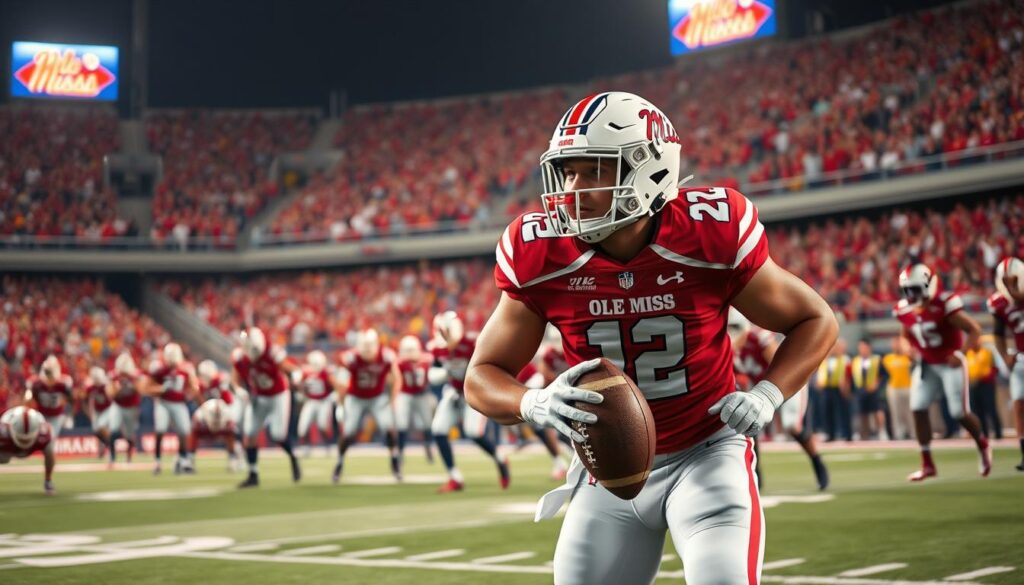
Quarterback Trindiad Chambliss is the heart of this chaos. He’s known for his “legendary gamer mentality.” He doesn’t just run an offense; he manipulates it. Pressure doesn’t scare him; it seems to make him sharper. He’s like a chess grandmaster playing checkers with a flamethrower.
Their goal is simple and scary: score against anyone. They don’t care about the clock. They aim to blow it up. Their spread-offense is designed to find mismatches and stretch defenses.
How do you measure a threat like this? Look at the numbers that show their chaos.
| Metric | Ole Miss (Playoff Avg.) | Miami Defense (Playoff Avg.) | The Threat |
|---|---|---|---|
| Points Per Game | 38.7 | 17.3 | Can Miami’s defense keep up with this firepower? |
| Yards Per Play | 7.2 | 4.8 allowed | Every snap is a chance for a big play. Discipline is key. |
| 3rd Down Conversion % | 48% | 31% allowed | They keep drives alive. They wear you down. |
| Red Zone TD Rate | 75% | 58% allowed | When they get close, they score. You can’t just bend. |
This table is more than data; it’s a warning. The Rebels turn chances into points with ease. For Miami, this game is the ultimate challenge, unlike anything in the ACC coastal schedule.
The threat isn’t just one player or a trick play. It’s the whole system’s focus on fast, relentless scoring. Stopping Chambliss and his offense is like trying to control a wildfire. Can Miami’s fierce front seven disrupt their rhythm? That might be the only way to win.
Key Position Battles
Forget the final score for a moment. The real drama of a football game unfolds in a series of high-stakes, one-on-one duels. Think of it less like a war and more like a heavyweight fight card. This weekend’s main event features three title bouts that will decide who leaves the Fiesta Bowl with their hand raised.
In one corner, you have Miami’s dynamic duo of destruction: Rueben Bain Jr. and Akheem Mesidor. These two don’t just rush the passer; they introduce quarterbacks to the turf with a concerning lack of ceremony. Their job is to turn the pocket into a panic room.
In the other corner stands an Ole Miss offensive line that just went twelve rounds with Georgia’s monsters and lived to tell the tale. They’re battle-tested, but are they Bain-tested? This is the classic clash of an unstoppable force meeting a recently immovable object. If Bain and Mesidor win early, the entire Rebel game plan gets thrown out the window.
Bout 2: The Aerial Theater (Miami’s Secondary vs. Ole Miss’s Air Raid)
Here’s where it gets fun. Miami’s secondary, led by the playmaking Keionte Scott—he of the “pick-six against Ohio State” fame—is brimming with confidence. They just made a room full of five-star receivers look average. Now, they face the Ole Miss spread, an offense designed to create space and exploit mismatches.
This battle is a chess match. Can Miami’s defensive backs maintain their discipline in coverage while also jumping routes? Or will the Rebels’ tempo and scheme create the explosive plays they thrive on? Scott and company aren’t just defenders; they’re ballhawks looking for another trophy.
Bout 3: The Inverse (Miami’s O-Line vs. Ole Miss Front)
This is the often-overlooked undercard with championship implications. All the talk is about Carson Beck’s arm and the running backs, but none of it matters if the UM football offensive line gets bullied. Their mission is simple: provide a clean pocket for Beck and carve out running lanes.
If they succeed, Miami’s offense becomes multidimensional and ruthless. If they fail, Beck will be running for his life, and the Canes’ attack becomes one-dimensional. This battle in the pit determines whether Miami’s playbook stays open or gets shut completely.
| Position Battle | Miami’s Combatants | Ole Miss’s Combatants | What’s at Stake |
|---|---|---|---|
| Defensive Line vs. Offensive Line | Rueben Bain Jr., Akheem Mesidor | Veteran O-Line (Georgia survivors) | Control of the pocket & offensive rhythm |
| Secondary vs. Passing Attack | Keionte Scott & Ball-Hawking DBs | Prolific Spread Offense | Big plays allowed/created & turnover margin |
| Offensive Line vs. Defensive Front | Miami’s Protecting Unit | Ole Miss Pass Rush & Run Stuffers | Time for Carson Beck & establishment of the run game |
So, who wins on points? It’s a three-round fight. Win two of these battles, and you’re likely celebrating a victory. For the Miami Hurricanes, the path to glory is paved in these individual matchups. The margin for error is thinner than a sheet of playbook paper.
Injury and Availability Report
For this edition of The U preview, we’re looking at a medical report like no other. We usually talk about ankles and ACLs. But the Miami Hurricanes, fresh from Ohio State, have a clean bill of health. No major injuries. It’s a minor miracle.
But the real story is in the team’s confidence. Is it on the injury report? More importantly, is it listed as “questionable” or “probable”?
The real check isn’t for bodies; it’s for energy and belief. Rueben Bain talked about a big “energy” shift at halftime against Ohio State. That’s not a pulled hamstring. It’s a contagious belief.
Physically, the Hurricanes are in great shape. You can read a positive injury report from their bowl prep. But the deeper analysis is on their spiritual strength.
Consider the alumni. The Reeds, Lewises, and Irvins are more than just names. They’re boosting the team’s morale. Warren Sapp’s words are like a pre-game meal for the soul.
So, let’s look at the Hurricanes’ true health chart. We’re moving beyond the physical and into the spiritual.
| Health Metric | Status | Impact Level | Game-Day Manifestation |
|---|---|---|---|
| Physical Condition | Excellent | High (Foundation) | Full participation in practice; no scheming around key absences. |
| Swagger / Confidence | Peak | Critical (Multiplier) | Aggressive play-calling; belief in clutch moments; defensive swarms. |
| Cultural Connection (Alumni) | Maximum Dosage | Psychological (X-Factor) | Playing for a legacy beyond the scoreboard; increased physicality. |
| Halftime Energy (per Bain) | Contagious | Momentum (Swing) | Strong third-quarter starts; resilience after adversity. |
See the difference? A team can be healthy. But the Miami Hurricanes are fortified. The intangibles are on the active roster and taking first-team reps.
In a game of inches, that spiritual surplus can make a big difference. It can turn a safe play into a game-changing moment. This isn’t mystic mumbo-jumbo. It’s the truth about momentum and belief at the top level.
The opponent will check the injury report for names. But they should check the condition of Miami’s mythos. It’s robust. That might be the most significant update of all.
Historical Head-to-Head
This isn’t your grandfather’s head-to-head analysis; it’s a psychodrama played out on a national stage. The actual win-loss record between these two programs is practically an afterthought. What matters here is the collision of historical paradigms—one program trying to reclaim its throne, the other trying to build one from scratch.
For Miami, every step in this playoff is haunted. The ghosts of The U’s past are demanding an audience. That 2001 championship team wasn’t just dominant; it was mythological. It represented a cultural takeover. Now, over two decades later, the program carries that legacy like an heirloom—precious but heavy. The current squad isn’t just playing for a title; they’re playing to reconnect a frayed wire to that iconic era.
Ole Miss walks a different path entirely. Their history isn’t a burden to bear but a blank page to fill. This “magical run” narrative is powerful precisely because it lacks the weight of expectation. There’s no dynasty to resurrect, only a new story to author. It’s innovation versus restoration. The Rebel’s quest is unburdened by tradition, making them dangerously free.
The broader context is what analysts are calling the “Parity Playoff.” New bloods are challenging the establishment. This game sits at the heart of that tension. The established power from the ACC coastal division, with its blue-chip history, versus the SEC upstart writing its own manual. It’s like a Netflix documentary waiting to happen.
| Historical Dimension | Miami Hurricanes | Ole Miss Rebels | The Contrast |
|---|---|---|---|
| Program Pedigree | 5 National Titles, iconic 80s-2000s dynasty | 3 SEC titles, often the bridesmaid | Proven winner vs. perennial contender |
| Defining Era | The Jimmy Johnson & Larry Coker years | The current Lane Kiffin resurgence | Legacy cemented vs. legacy in creation |
| Championship Drought | 23 years (sine 2001) | Never won modern CFP/BCS title | Remembering glory vs. chasing first light |
| Cultural Identity | Swagger, turnover chain, “The U” | Underdog grit, “Mississippi grind” | Confident aristocracy vs. hungry meritocracy |
This head-to-head narrative transcends the field. It’s about what kind of story college football wants to tell itself. Do we prefer the satisfying arc of a fallen giant’s return? Or the thrilling unpredictability of a new champion’s coronation?
Miami’s path through the ACC coastal was supposed to be a warm-up for this moment. Instead, it became a proving ground for their championship mentality. Each coastal clash tested their resolve, preparing them for this ultimate historical reckoning. The conference schedule wasn’t just about wins; it was about rebuilding a champion’s psyche.
Ole Miss, meantime, treated the SEC gauntlet as their audition. Every upset, every comeback, was a statement that they belonged on this stage. Their history isn’t in trophies but in momentum—a snowball effect that’s carried them to the semifinals.
So who wins this historical head-to-head? The program weighed down by glory or the one lifted by possibility? The answer will define more than a season. It will signal whether college football’s old guard can hold the line or if the gates have truly been stormed. The ACC coastal stalwart versus the SEC insurgent. Tradition’s last stand or innovation’s breakthrough moment. Place your bets.
X-Factor Players to Watch
While coaches plan out plays, it’s the unexpected players who often win the game. For UM football fans, finding these surprises is key. They turn good strategies into powerful psychological attacks.
The UM football defense is not just strong; it roars. Rueben Bain Jr. is a defensive end who inspires with every snap. His famous halftime speech was more than motivation; it was a lesson in leadership. When Bain speaks, the defense listens, and quarterbacks feel the pressure.
Statistics show tackles and sacks. But they don’t capture the contagious intensity that makes a defense unstoppable. Bain’s presence alone changes the game.
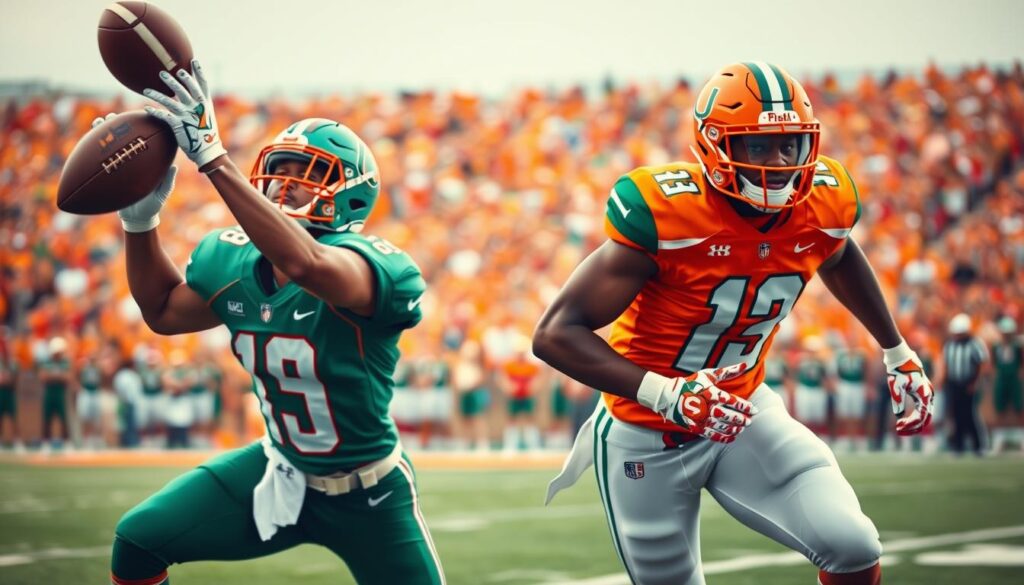
Keionte Scott, the defensive back, sees footballs as personal challenges. His two pick-sixes this season are not luck; they’re a pattern of interception. This UM football secondary has a star, and he doesn’t just take the ball. He takes points away and adds to his own score.
Scott’s skill is in reading quarterbacks. He jumps routes before the receiver even moves. This kind of defensive smarts is worth six points every time.
Offensively, Carson Beck is a steady force. He may not have flashy speed, but he has unflappable composure. The UM football offense runs smoothly under his guidance, always thinking ahead.
Beck’s strength is his calm under pressure. He prepares so well that even under intense situations, he remains focused. This calm is as valuable as any strong arm.
For Ole Miss, Trindiad Chambliss is the X-factor. He’s not just a quarterback; he’s a master of chaos. In tight spots, his instincts kick in, making him even more dangerous.
Chambliss shines in moments that break other quarterbacks. His game is like improvisational theater, with touchdowns as the applause.
| Player | Team | Position | X-Factor Trait | Psychological Ripple |
|---|---|---|---|---|
| Rueben Bain Jr. | Miami | Defensive End | Emotional Leadership | Elevates entire defense’s intensity |
| Keionte Scott | Miami | Defensive Back | Pick-Six Instinct | Creates offensive points from defense |
| Carson Beck | Miami | Quarterback | Game Management | Provides stability under pressure |
| Trindiad Chambliss | Ole Miss | Quarterback | Chaos Creation | Forces defensive hesitation |
The battle here is fascinating. Bain’s energy versus Chambliss’s chaos. Scott’s quick thinking versus Beck’s calm. These aren’t just physical battles; they’re competing philosophies of pressure.
Who will have their “Joaquin said dominate” moment? Bain is ready for another inspiring speech. Scott is due for his third interception. Beck could silence critics with one perfect drive. Chambliss might just break the game open when it seems closed.
Watch these four players more than any play. They’re the unpredictable elements that algorithms can’t predict—the living, breathing X-factors who change the game.
Tactical Matchup Analysis
Imagine a sumo wrestler trying to catch a gazelle. That’s what we’re looking at here. It’s not just another game; it’s a clash of football styles. Miami plays tough, like a war, while Ole Miss spreads out and uses speed.
Analysts like Chris Hummer say Miami’s strength in the trenches is key. They think Miami’s defense can stop Ole Miss’s fast offense. This The U preview asks if Miami can use its strength to win.
Mario Cristobal wants Miami to control the game with strength. They’ll run the ball a lot to control the clock. Miami aims to make Ole Miss feel trapped.
Lane Kiffin might do the opposite. He might use speed to outmaneuver Miami. Ole Miss will try to spread Miami’s defense and use quick passes to get around them.
| Tactical Element | Miami’s Approach | Ole Miss’s Approach |
|---|---|---|
| Philosophy | Brute-force physicality, control the line | Finesse and speed, spread the field |
| Tempo | Methodical, clock-controlling drives | Up-tempo, no-huddle to create fatigue |
| Key Battle | Miami DL vs. Ole Miss OL | Ole Miss WRs vs. Miami secondary |
| Win Condition | Fourth-quarter attrition | Big-play explosion early |
Miami’s defense might use complex schemes to confuse Ole Miss. Or, they might rely on their front four to rush the quarterback. Look for hidden blitzes that could pressure the quarterback.
Ole Miss needs a clean pocket to succeed. If Miami’s defense can rush the quarterback, it could be a long day for Ole Miss.
This is a battle of wills between the coaches. Will Miami’s tough style win out, or will Ole Miss’s speed and quick plays succeed? The halftime adjustments will be key.
Miami wants to wear Ole Miss down, while Ole Miss aims to score quickly. Which approach will work? That’s the big question for Saturday.
Vegas Lines and Predictions
The Vegas line makes Miami a slight favorite. But, experts have different views. Some, like CBS Sports’ Tom Fornelli and Shehan Jeyarajah, think Miami’s defense is key. Others, like Brandon Marcello and 247Sports’ Chris Hummer, see Ole Miss’s offense as the big threat.
Marcello’s insight is striking. He says Miami might need to score four touchdowns to win. The Hurricanes haven’t done that in the postseason yet. This is the game’s main question.
The Canes’ defense has been strong, leading them through the ACC coastal and beyond. Can their offense now keep up against a top SEC team?
We face two opposing ideas. Is it hard to beat a great team twice? Or is Miami’s recent defensive success the smarter bet? The data shows Miami’s strategy has worked without needing 28-plus points. Ole Miss might change that.
Our prediction is clear. Miami’s defense is top-notch, shaping the ACC coastal story this season. We think it will disrupt Ole Miss enough. Tyler Van Dyke’s offense will score that extra touchdown Marcello mentioned. We predict a close, intense 24-20 win for Miami. This sets up a national title game where Miami’s defense will face another big test.