

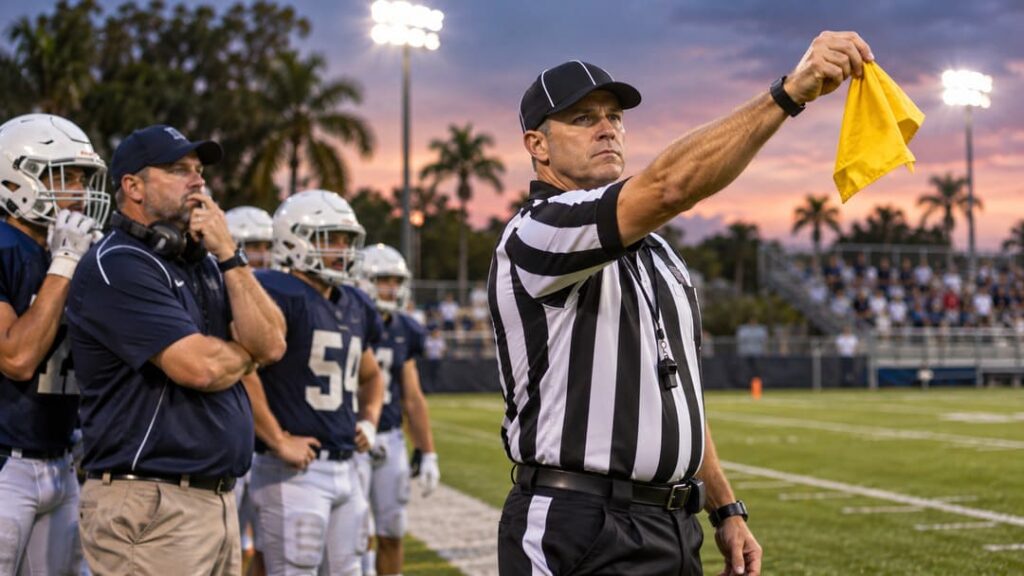
A Florida high school football player who is ejected for an unsportsmanlike act or a flagrant foul cannot simply sit out the rest of Friday’s game and start fresh next week. Under the FHSAA’s 2026–27 rules, a Level 1 suspension means missing the remainder of that contest and at least the next contest. More serious or repeated misconduct can bring longer suspensions, including during the playoffs.
For additional information about penalties and officiating regulations, readers can explore our Florida High School Football Rule Changes 2026 guide to better understand the rules governing high school games.
The distinction matters because a penalty, a disqualification and a subsequent suspension are not the same decision. A 15-yard flag changes the game on the field. Disqualification removes someone from that game. The FHSAA’s disciplinary policy determines what happens afterward.
When a penalty becomes an ejection
Under the NFHS’s 2026 football points of emphasis, ordinary unsportsmanlike conduct includes non-contact behavior such as taunting, threatening gestures, excessive celebrations, profanity or arguing with an official. The standard penalty is 15 yards. A player who receives two unsportsmanlike conduct fouls in the same game is disqualified.
A flagrant foul follows a different path. The NFHS describes it as particularly serious misconduct, such as fighting or violent illegal contact that puts an opponent at risk. A flagrant foul carries a 15-yard penalty and immediate disqualification. It does not take a second flag. By contrast, an ordinary non-flagrant personal foul does not automatically mean the player must leave the game.
That difference explains why two plays that look equally heated from the stands may produce different consequences. The official’s classification of the conduct matters, and a crowd’s reaction or a short social-media clip is not an official disciplinary ruling.
Florida football ejection rules extend beyond the final whistle
The 2026–27 FHSAA Handbook’s Policy 30 sets out the consequences after a qualifying ejection. A Level 1 suspension makes the athlete ineligible for the rest of the game and at least the next contest at the same level. The policy also prevents the athlete from entering another interscholastic contest in any sport while the suspension is in effect.
A second Level 1 suspension, or other misconduct covered by the more serious category, can trigger Level 2. In football, that means a suspension of at least one contest and up to five, as determined under the policy. Particularly egregious or repeated misconduct can bring still more serious discipline. Not every ejection therefore results in an identical one-game absence.
There is also a rule for the season’s final game: if an applicable suspension cannot be served because the season has ended, the handbook carries the ineligibility period into the next sport the student participates in. A team being eliminated does not, by itself, erase the disciplinary consequence.
Why celebrations and sideline behavior matter
Players sometimes copy the celebrations they see on Saturday college broadcasts or Sunday professional games. High school rules are not necessarily the same. The NFHS emphasizes conduct directed at opponents, excessive demonstrations and gestures that threaten or demean others. A quick reaction to an exciting play is not automatically the same as deliberate taunting, but officials must judge the conduct they see.
Coaches and other team personnel have responsibilities too. The 2026 NFHS guidance addresses sideline control and actions such as leaving the coaching area to confront officials. The FHSAA handbook separately sets suspensions for coaches who are ejected. Those sanctions can affect who is permitted to coach or attend a following contest, not simply where a person stands during the current game.
This is particularly consequential in November. A postseason team may have only a week to prepare for its next opponent, so losing a starting player or coach can change practice plans and game-day availability. That is an operational consequence of the rules, not a prediction about any team’s result.
What schools must do after an ejection
Policy 30 requires the school to report an unsportsmanlike act or flagrant foul that led to an ejection within one school day. The report is to include an account of the incident and available video or other pertinent documentation. The school must then enforce the applicable suspension; the FHSAA says participation by an ineligible player results in mandatory forfeiture.
Schools can also face consequences beyond an individual’s absence. When more than three students from one school receive suspensions in the same sport, the handbook provides for administrative probation beginning with the fourth suspension, with possible monetary penalties and other sanctions. Multiple players joining an altercation can create additional school-level exposure.
For families, the sound response is to ask the athletic director what the official ejection report says, whether a suspension has been assessed and when the athlete may compete again. An appeal or review should not be assumed to cancel a suspension unless the responsible authority confirms the athlete’s status. Public speculation about a minor’s behavior is not a substitute for the school’s documented process.
A penalty can cost 15 yards; an ejection can cost the rest of a season-defining game and at least the next one. Understanding the sequence helps fans interpret a flag while giving schools a clear priority: verify eligibility before putting anyone back on the field.