

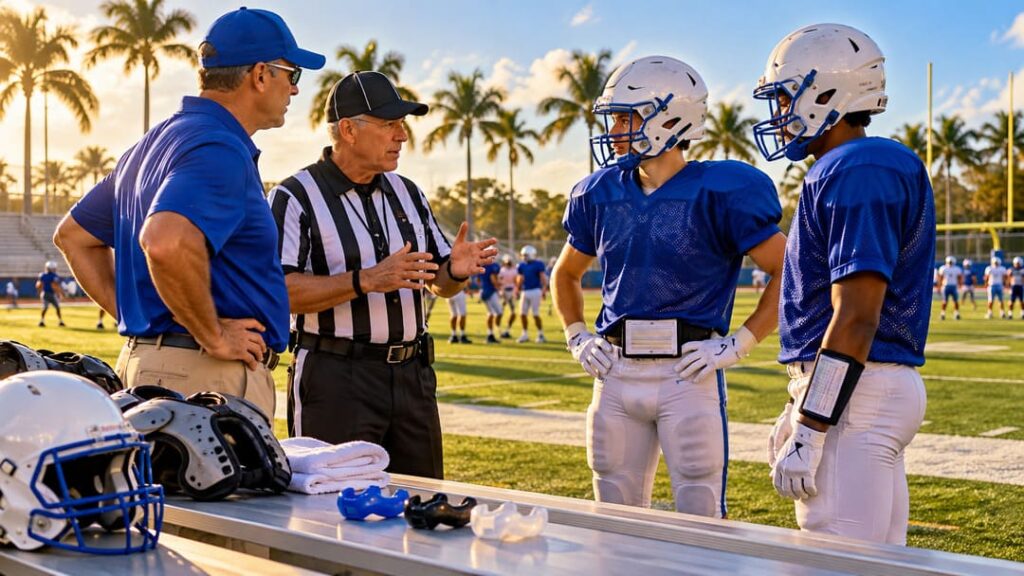
The biggest 2026 high school football rule changes are easy to miss during a Friday-night game. Slapping an opponent’s head with the hands is now explicitly prohibited for both offensive and defensive players, play-call cards may be worn on a player’s belt, and new restrictions on mouthguard attachments take effect this season. A widely discussed arm-sleeve equipment standard, however, does not take effect until 2027. They also do not replace Florida’s environmental protections, which are explained in the site’s football heat-safety guide.
These are national high school rules with a direct Florida connection. The 2026-27 FHSAA Football Sport Manual adopts National Federation of State High School Associations (NFHS) playing rules, subject to Florida-specific modifications. That means families should not assume the NFL or college rulebook explains what is legal in an FHSAA contest.
Head Slaps: The Same Prohibition for Both Sides of the Ball
Previously, NFHS Rule 9-4-7 specifically barred a defender from slapping a blocker’s head. The NFHS announcement of the 2026 football revisions explains that the wording now applies to all players. An offensive lineman does not get a different exception simply because the team has possession.
This is a rule about a prohibited hand slap to an opponent’s head, not a claim that every incidental touch of a helmet is automatically the same foul. The useful coaching adjustment is to review hand placement and blocking technique on both sides of the line, rather than teaching the rule as a defensive-only concern.
Play-Call Cards Can Move From the Wrist to the Belt
A quarterback’s play card is the small list of coded calls used to communicate the offense’s next play. Before the revision, these cards could be worn on the wrist or arm. The 2026 rule adds the belt as a permitted location.
That change gives teams a practical alternative when wrist-mounted cards are difficult to read around pads or during a hurried substitution. It does not create a new right to use an earpiece or live in-helmet coaching communication. The permitted placement of a printed card and the legality of electronic communication are separate questions.
Mouthguards Change in 2026; Arm-Sleeve Standards Wait Until 2027
Some equipment requirements were approved earlier but intentionally assigned later effective dates. The NFHS equipment and rules-change document establishes that mouthguards cannot have attachments that serve no protective function or components that create a safety risk, beginning with the 2026 season.
The distinction matters when a player has a decorative add-on attached to an otherwise usable mouthguard. The stated restriction targets nonprotective attachments and potentially dangerous components; it is not, by itself, a blanket ban on every colored mouthguard. Teams can avoid an unnecessary equipment dispute by checking mouthguards before game day and asking school staff or officials about uncertain products.
The same NFHS document sets a 2027, not 2026, effective date for the new Sports and Fitness Industry Association (SFIA) specification covering arm sleeves manufactured to enhance contact with the ball or an opponent. Those sleeves will need an appropriately visible, permanent SFIA mark when that requirement takes effect. Describing this future standard as a universal 2026 prohibition would give players and parents the wrong deadline.
A separate 2025 rule update permitted certain non-audio sideline electronic signs but continued to prohibit in-helmet communication under NFHS rules. That provides another reminder that a technology used in college football is not automatically permitted in a Florida high school game.
The ‘Tush Push’ Difference Is an Enforcement Priority, Not a New Rule
The most consequential misunderstanding may concern short-yardage plays. In college and professional football, teammates can directly push a ball carrier from behind. NFHS rules distinguish between pushing the pile, which can be legal, and deliberately pushing, pulling or lifting the runner forward, which is prohibited.
The NFHS 2026 points-of-emphasis guidance tells officials to watch for direct assistance to the carrier, especially near the goal line or first-down marker. The act of illegally helping the runner was already prohibited; its appearance on the 2026 emphasis list means officials have been asked to pay particular attention to enforcement, not that every push around a pile became a new foul this year.
For a spectator, the key is who is being pushed: a blocker contributing to the pile is different from an offensive teammate directly driving the ball carrier forward. The official must judge the actual contact and whether it clearly assists forward progress.
The other NFHS emphasis areas for 2026 address flagrant and unsportsmanlike fouls, sideline control, and the required authenticating mark on game balls. They are areas of renewed enforcement attention, not four newly invented rules.
What Florida Teams and Fans Should Check
Before the next game, teams have a short practical list: teach legal hand contact to offensive and defensive linemen; check mouthguards for unsafe or nonprotective attachments; confirm that a belt-mounted play card is securely worn; and rehearse short-yardage blocking without directly assisting the runner. Coaches and sideline personnel should also respect restricted areas and equipment requirements.
The rule changes carry into postseason contests, although qualification and hosting are separate subjects covered in the site’s 2026 FHSAA playoff structure guide.
The practical lesson is to separate new 2026 wording, already-existing rules that officials are emphasizing, and equipment standards scheduled for 2027. Doing so helps players prepare properly and helps fans understand why a legal-looking college play may draw a flag on a Florida high school field.