

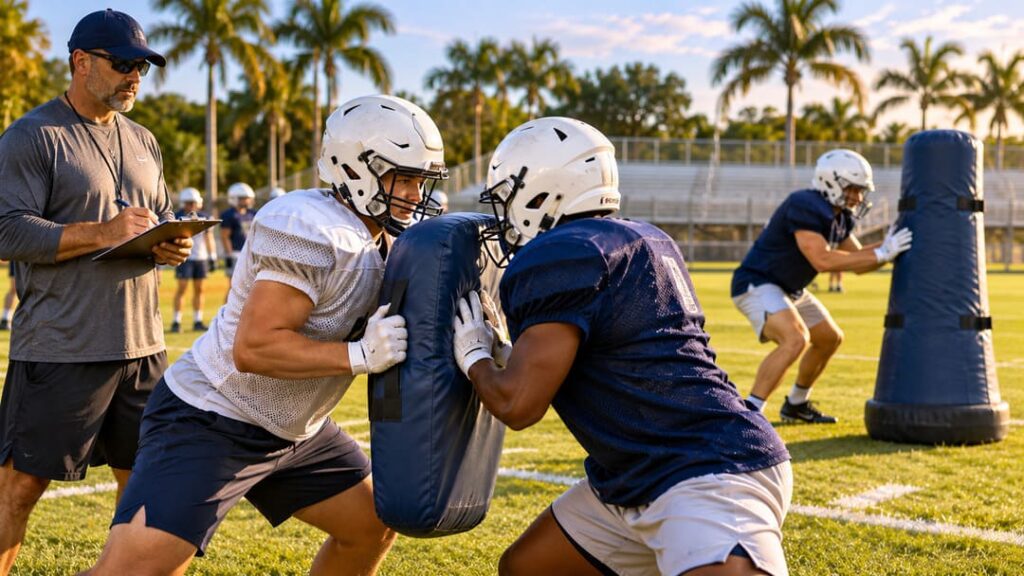
During Florida’s 2026 postseason, a high school football team cannot schedule unlimited full-tackle practice. The FHSAA permits no more than 30 minutes of live contact per practice day and 80 minutes per week, on at most three practice days, with no more than two consecutive days of live contact. But it separately permits unlimited air, bag and thud drills. The distinction rests on what happens during the drill, not simply whether the players wear full pads.
The rules are stated in Section 4.7.3 of the 2026–27 FHSAA Football Sport Manual. For parents, players and coaches, the important point is that “not live contact” does not mean “no impact.” A controlled standing collision and a full takedown are different activities, and neither should be confused with a noncontact walkthrough.
What Florida calls air, bags, thud and live contact
Florida’s definitions distinguish drills by their opposition and whether athletes are taken to the ground.
| Practice activity | What players do | Counts toward the FHSAA live-contact limit? |
|---|---|---|
| Air or bags | Work unopposed, or against a bag or other soft-contact surface | No |
| Thud | Make contact above the waist, take a few steps, then disengage; no one is tackled to the ground | No |
| Live contact | Practice in game-like conditions in which a player can be taken to the ground | Yes |
The manual describes thud as contact that ends after the first two or three steps, with everyone remaining on their feet. A practice does not become a live-contact session merely because helmets and shoulder pads are worn. Conversely, calling a drill “thud” does not make it so if players are routinely completing tackles to the ground.
Coaches and players can also review our Florida High School Football Rule Changes 2026 guide for additional context on the rules governing high school football.
How the 80-minute weekly cap works
Four limits apply together during the regular season and postseason: a maximum of 30 live-contact minutes in one practice day, 80 minutes in one week, three live-contact practice days per week and two consecutive such days.
For example, a hypothetical schedule of 30 minutes on Monday, 30 on Wednesday and 20 on Friday totals 80 minutes and leaves a break between contact days. Scheduling 30 minutes on each of those three days would total 90 minutes and exceed the weekly cap, despite staying under the daily cap. Three consecutive live-contact days would also violate the separate consecutive-day limit.
Earlier in the year, the limits differ. During the initial five-day acclimatization period, deliberate player-to-player contact is prohibited. Later in the preseason, the manual permits up to 40 minutes of live contact per day, with no more than two consecutive practice days containing it. Those preseason provisions should not be carried over into a November playoff practice plan.
The head coach must prepare a written plan before every practice and the school must retain those plans for at least 12 months. This gives administrators a concrete way to review how contact periods were scheduled rather than relying on a general description of a practice as “light.”
Why thud deserves attention even though it is exempt
The Florida manual’s live-contact definition is narrower than the language in some national training guidance. USA Football’s Levels of Contact framework groups thud and live drills under full-contact training levels, while distinguishing the quick whistle and standing finish in thud from the game-like action of live drills. These are different classification systems, not interchangeable legal standards.
Research offers an additional reason not to treat the terms as safety guarantees. In a 2022 multisite study of 74 high school football players, researchers recorded 7,312 head impacts during a season. Adjusting for time spent in different drills, head-impact exposure was greater in thud and live activity than in lower-intensity drills. The study involved three schools and cannot establish the concussion risk of any individual Florida player, but it helps explain why drill intensity matters even when no one is tackled to the turf.
The CDC’s concussion-prevention guidance likewise recommends limiting contact practices, enforcing rules against head-first hits, and encouraging athletes to report symptoms. Reducing live-tackle minutes is one tool for managing exposure; sound technique, appropriate supervision and prompt response to suspected injury remain necessary throughout practice.
What families and coaches can take from the rule
The useful questions are specific: Which periods of practice involve a possible takedown? How many live-contact minutes are scheduled this week? Do consecutive contact days comply with the limit? Are standing-contact drills ending when planned? A coach should be able to answer those questions from the written practice plan without exposing any student’s private medical information.
Florida’s policy is not a ban on football contact, nor is it permission to make every non-live drill as forceful as possible. It sets a measurable ceiling for tackling to the ground while leaving teams room to teach positioning, blocking and pursuit through less intensive drills. The distinction is especially valuable late in the season, when teams need to prepare for meaningful games without assuming that more collisions automatically produce better preparation.