

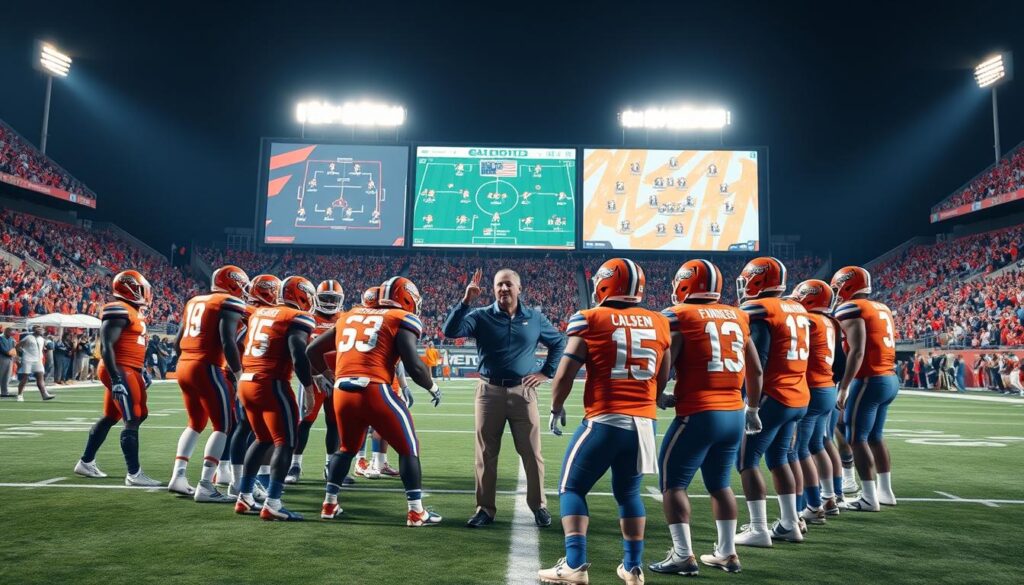
Let’s dive into the film room. The promotion of Russ Callaway to offensive coordinator is more than just a title change. It’s a bold statement from the Swamp. It suggests a big change in how the team plays.
This move raises a key question. Is this the start of a real change for the Gators offense, or just a new look for old ideas?
Callaway brings a new style, inspired by the Air Raid. He wants to use new strategies like the “mesh” concept. He also plans to give running backs a bigger role in passing plays. This is a big change for the team.
This is like your pre-game show. We’re setting the stage and asking why this change is happening now. Our analysis will check if the excitement is real or just hype.
Formation Analysis and Trends
The alignment of eleven bodies before the snap is more than just organization. It’s a statement of intent, a test for defensive coordinators. Does a tight end set with two tight ends show brute force or a play-action trap? Modern offenses, like those in the SEC strategy, see formations as dynamic scripts, not static pictures.
It’s like psychological warfare before the game starts. A spread look with four receivers shouts “pass” loudly. But what if it’s a run? That confusion is what coaches like Scott Frost use to their advantage, making formations more dynamic.
Motion is where the magic happens. A player moving from one side to the other makes the defense’s plans disappear. Is the H-back a blocker or a receiver? An empty set with five wide receivers might look weak, but it forces the defense to make tough choices.
This isn’t just about being new. It’s about making the defense unsure. Research shows that pre-snap movement can break defensive keys, creating confusion. A half-second of hesitation can win the play.
For Florida, the question is what new play-caller Will Callaway will bring. Will he use shifts like Frost, presenting one look and then attacking with another? The goal is to make the defense feel trapped, like in a zugzwang situation.
This is the heart of elite SEC strategy. In a place where athleticism is common, the mental game is what sets teams apart. Formations are not just about what happens but also why and how. They are the start of a case to break an opponent’s will, one adjustment at a time.
Quarterback Development Progress
Florida’s offense needs a star quarterback to shine. DJ Lagway is the key player. He must turn play calling into action on the field.
Lagway has the skills to be great. He has a strong arm and can dodge defenders easily. But, the real challenge is in his mind.

The offense and Lagway work together like a dance. Billy Napier’s system uses RPOs and options. This makes Lagway’s job easier but also harder.
He needs to read the defense quickly and make smart choices. The play calling helps, but Lagway’s growth is what makes it work.
Training is just the start. Lagway needs to go beyond knowing the playbook. He must own the game.
| Aspect | Quarterback Training Focus | Quarterback Development Focus |
|---|---|---|
| Mental Processing | Memorizing play concepts and progressions. | Recognizing defensive leverage and coverage disguises in real-time. |
| Defensive Recognition | Identifying basic coverage shells in film study. | Diagnosing coverage rotation and blitz packages from empty and spread sets. |
| Play Execution | Throwing with proper mechanics and footwork. | Making the correct post-snap read on an RPO, deciding to hand off, pull, or pass. |
| System Integration | Running the play as it’s drawn on the board. | Understanding how each play calling concept attacks a specific defensive vulnerability. |
Lagway’s growth means more than just running plays. He must solve them. In an empty set, he’s not just five receivers. He’s a tool to diagnose the defense.
His pre-snap read tells him what to do next. This turns the play calling into a dynamic tool.
The best systems ask quarterbacks to manage the game. Lagway’s job is to answer the defense’s questions. He must solve problems fast and accurately.
Watching Florida’s offense, look at Lagway’s eyes and feet. Is he calm and decisive? That’s development. Or is he hesitant? That’s a work in progress. The scheme is the language, but Lagway must speak fluently.
Running Game Effectiveness
Imagine if Montrell Johnson’s most valuable carries were when he didn’t touch the ball. Welcome to the modern running game, where success is about causing defensive headaches, not just gaining yards.
Forget about the old days of three yards and a cloud of dust. Today’s running game is a complex system. It shapes defenses to open up other plays in the playbook.
Johnson, a big back, playing in the slot is key. It creates a huge mismatch against the nickel corner. This isn’t just a trick play. It’s a smart use of players.
When Johnson moves back to the backfield, the defense must rethink their plan. They wonder if it’s a run or a pass. This moment of doubt is where the Gators offense shines.
The zone read, a classic, gets a 2024 update. It’s no longer just a battle between the quarterback and defensive end. Now, it’s a way to punish defenses for overcommitting.
Pin-and-pull sweeps and power schemes are used together. They create stress and attack the A-gap. But they’re not used alone. They’re part of a bigger plan.
Run power twice, then show the same look and run a pin-and-pull. The linebackers who rushed down get stuck. The safety who moved up gets beaten.
This “window dressing” isn’t just for show. It’s a clever trick. The offense shows one thing to get the defense to react, then uses those reactions to their advantage.
Here’s how Florida’s main run plays work together:
| Run Concept | Primary Objective | Setup Mechanism | Defensive Dilemma |
|---|---|---|---|
| Zone Read | Force DE to choose; create numbers advantage | QB mesh point hesitation; backside TE release | Commit to QB = give up edge; commit to RB = QB keeper |
| Pin-and-Pull Sweep | Attack perimeter with speed | Motion receiver; pulling guard/tackle combo | Outside leverage = cutback lane; inside leverage = outflanked |
| Power | Vertical push at point of attack | Fullback/H-back lead; down blocks | Fill gaps = play-action vulnerable; stay back = yardage gained |
| Counter | Exploit over-aggressive pursuit | False step; opposite direction pullers | Flow with initial action = wrong gap; stay home = outnumbered |
Each play targets a different defensive instinct. The zone read tests discipline. Sweeps attack speed. Power schemes test toughness. Counters exploit aggression.
The best part? These plays work together. Run power twice, and linebackers will overcommit. Then, call the counter, and watch them get out of position.
Johnson’s ability to play both ways is key. If he’s a threat from the slot, defenses must keep a safety close. This opens up the outside for passing plays without needing a new call.
Success isn’t just about big games. It’s about converting third downs. It’s about safeties creeping up. Most importantly, it’s about the defensive coach’s headaches during timeouts.
The running game is the setup man. It prepares defenses for big passing plays. It controls the pace. It dictates who plays where. In the Gators offense, the run game is the foundation of everything.
Passing Attack Innovation
Florida’s passing attack doesn’t need new ideas. It just needs to make simple routes look complex. Think of it as making the playbook look like a magic show, not a horror movie.
The “mesh” concept is a great example. Two crossing routes over the middle might seem basic. But, running it when linebackers are distracted by a fake RPO is the real trick. It’s not just the route, but the timing and the confusion it creates.
Billy Napier’s background, influenced by the Air Raid, brings simplicity and speed to the game. The Air Raid focused on quick, simple plays. Today, it’s about adding a layer of strategy to those plays, making them part of a bigger trap.
Let’s look at the key areas for passing innovation:
- RPOs as Coverage Dictators: A zone read with a bubble screen isn’t just a play. It’s a way to see how the defense reacts. This tells the quarterback where to attack next.
- The “Now-You-See-It” Arrow Screen: This screen pass is set up to look like a run play. Then, a receiver in the flat gets the ball, catching the defense off guard. It’s a key part of any top SEC strategy.
- Roll-Out Throwbacks: This play is all about misdirection. The offense looks like it’s going one way, then the quarterback throws back to a receiver going the other way. It’s a surprising twist in football.
The real magic is in the setup. Using formation to dictate coverage is key. If you have two receivers close to one side, you’re inviting a safety to cheat over. This shows you where the defense is weak, and you can attack there.
Pre-snap motion is like a magician’s trick. A jet sweep motion can distract a linebacker for just a moment. This creates a chance for a slant route. The motion changes the defender’s perception of the play, making it explosive.
For Florida, the path forward is clear. Use the Air Raid’s quick throws as a base. Then, add modern touches like pre-snap motion and post-snap constraints. This way, you can run a play that fits a specific defense’s look. That’s how you control the game with an SEC strategy.
The quarterback’s role changes to a coverage detective. He looks at the outside linebacker’s alignment first. If they’re expecting a run, it’s time to pass. The innovation is in identifying these tells before the snap.
In Gainesville, a top passing game is simple yet precise. It uses four verticals to clear space for a delayed route. It makes a basic curl-flat combo look like a run play until the ball is thrown. Florida’s SEC strategy evolves by making the defense doubt itself.
Red Zone Efficiency
In the red zone, play calling is like solving a complex puzzle. Every choice is critical. A single mistake can cost you dearly.
The field shrinks to just 20 yards. This tight space makes every decision more intense. It’s where coaches prove their worth or face harsh criticism.
The game’s geometry changes dramatically. Passing windows become tighter, and running lanes vanish quickly. Defenses can press harder, knowing they have less space to cover.
Florida’s offense faces a key decision. Should they use heavy formations for a run look before passing? Or spread the defense thin with four-wide sets?
They likely do both. True red-zone genius lies in unpredictability. Using the defense’s expectations against them is key.
Let’s look at the strategic options. Each approach has its own unique style, like characters in a heist movie.
| Strategy | Formation | Key Advantage | Risk Factor |
|---|---|---|---|
| Power Run Focus | I-Formation, Heavy Personnel | Physical dominance, clock control | Predictable, needs elite line play |
| Spread Passing Attack | 4-Wide, Empty Backfield | Creates mismatches, stretches defense | Protection issues, QB pressure |
| Play-Action Misdirection | Heavy sets that look like run | Capitalizes on defensive aggression | Timing dependent, requires sell |
| RPO Quick Game | Shotgun with multiple options | Post-snap decision making | QB injury risk, complexity |
Florida might use “schematic schizophrenia.” Show different looks to keep defenses guessing. One drive might be power football, the next a five-wide spread.
Constraint plays are key. They punish defenses for overplaying your tendencies. Use a bubble screen if they stack the box, or a draw if they’re soft.
The most beautiful touchdown I’ve seen was a masterful trick play. A goal-line package with three tight ends fooled the defense. The quarterback faked a handoff and threw a pass to a tight end who had “blocked” before releasing into the end zone.
That’s the level Florida should aim for. Red zone efficiency is about scoring with style and smarts. It’s the difference between 7 points and 3 points, between winning and losing.
In the end, red zone play calling is about understanding human psychology and football strategy. Know what the defense expects and how to make them wrong. Do that, and you’ll win more often.
Third Down Conversions
If tempo is the Gators offense chosen weapon, then third down conversions are its ammo. Fail, and the whole up-tempo plan falls apart. Convert, and the defense is left struggling.

“Hurry-up” plays aren’t just a choice; they’re a strategy to confuse defenses. This makes the defense slow to react, like playing chess too fast. The offense uses quick, practiced plays, while the defense tries to keep up.
For the Gators, it’s not about holding onto the ball. It’s about keeping the defense under pressure. Every third-down success adds to the mental strain on the defense. They can’t change their game plan or players.
So, what does the Gators’ offense do on third down? They might go for a quick pass or a big play. The choice depends on the situation.
The beauty of a good Gators offense on third down is the clear outcome. Success means the defense can’t reset. Failure, on the other hand, can stop the momentum.
Success on third down needs more than just talent. It requires careful planning and practice. The quarterback must read the defense quickly. The line and receivers must communicate perfectly. There’s no time for mistakes.
In conclusion, third-down success is key for the Gators’ offense. Even with speed, failing on third down means losing the game. For a team that values speed, converting on third down is essential for survival.
Offensive Line Performance
In the SEC strategy playbook, trench warfare is real. It’s the hard, unglamorous part that decides which offenses do well and which barely make it. Think of your offensive line as the base of a skyscraper. Without a strong base, the whole thing falls apart.
The data shows a key point. New run schemes and pass protections help the offensive line. It’s not about being stronger. It’s about being smarter. It’s the difference between moving a mountain and using a lever.
Modern systems change the job of linemen. They need to be athletes, not just anchors. The old-school linemen were like bulldozers—slow but strong. Now, they need to be agile and quick, making fast decisions.
This change brings new challenges. Your play-action game works only if your line can sell it well. Your tempo offense needs linemen who can keep up. RPOs depend on your guard reaching linebackers fast.
This is where SEC strategy really shines. The best coordinators design around their line’s strengths. If your left tackle is a star, build your protection around him. If your guards are quick but small, use wide zone runs to make them chase.
The table below shows how different schemes need different linemen. It’s the key to understanding modern trench warfare.
| Scheme Type | Physical Demand | Mental Demand | Ideal Lineman Profile | Common SEC Use |
|---|---|---|---|---|
| Outside Zone | High agility, lateral movement | Medium – timing & coordination | Athletic, lighter, mobile | Georgia, Alabama |
| Power/Gap | Raw strength, drive blocking | Low – straightforward assignments | Heavy, powerful, mauler | Traditional LSU, Arkansas |
| RPO-Heavy | Mixed – quick sets & run blocking | Very High – read & react | Smart, versatile, quick processor | Florida, Ole Miss |
| Play-Action Deep | Pass protection stamina | High – sell run, protect longer | Long arms, patient, technical | Texas A&M, Tennessee |
Notice the pattern? The most innovative offenses need the smartest linemen. It’s not just about blocking. It’s about reading the defense and making quick decisions. That’s a lot for 300-pound men.
Mastering SEC strategy means understanding a simple truth. Your offensive line is your limit. You can scheme around weak receivers or running backs. But you can’t hide a bad offensive line. They touch the ball every play.
The silent substrate is actually screaming if you know how to listen. Every quarterback pressure tells a story. Every stuffed run play shows a weakness. Coordinators who win build their offense on a solid foundation of smart, adaptable trench warfare.
Skill Position Usage
What’s a “skill position” in modern football? It’s not just about running or catching. Today, players must do it all. Florida’s football has become more versatile because of this.
Running backs are more than just runners. Montrell Johnson catching screens is now common. This makes simple plays into big challenges for the defense.
Take the H-back role, for example. Arlis Boardingham is more than a tight end. He blocks, stretches the defense, and creates mismatches. Moving him around forces the defense to react. This is where smart play calling comes in.
Billy Napier’s system is all about keeping the defense guessing. Is it a slot receiver or a running back? The defense doesn’t know until the play starts. Every formation is a puzzle, and every player is a surprise waiting to happen.
Florida’s offense is complete with its skill players. The line blocks, the quarterback reads, and the skill players are the wild cards. Their ability to do it all makes the offense powerful. Good play calling turns players into game-changers.