


Jadan Baugh impact became harder to frame as early-season promise after his September 19, 2026 road performance against Auburn. Florida’s running back carried 26 times for 162 rushing yards and three touchdowns in that Southeastern Conference matchup, including a 53-yard touchdown run. That followed two productive non-conference games, giving the Gators a three-game sample that says more than a one-week hot streak.
Through September 19, 2026, Baugh had 54 carries for 458 rushing yards and eight rushing touchdowns across Florida’s first three games. The shape of that production matters. He was explosive in the opener against Florida Atlantic on September 5, efficient again against Campbell on September 12, then handled a heavier workload against Auburn one week later. For a Florida offense under Jon Sumrall, that blend of burst and volume is the clearest player-performance story of the opening stretch.
Why The Jadan Baugh impact Shows Up Fast
The first layer is simple: Baugh has turned touches into points. On September 5, 2026 against Florida Atlantic, he rushed 14 times for 160 yards and three touchdowns, with a 61-yard run. Florida won that opener 66-21, and Baugh’s rushing output was part of a scoring surge that marked the Gators’ highest-scoring season opener since 1994. Florida’s official site also framed his return in the context of his late-2025 form, including his 266-yard game against Florida State on November 29, 2025 Florida feature on Baugh.
Jadan Baugh impact In The Auburn Game
The Auburn game changed the early read because it paired production with usage. Fourteen carries in each of the first two games showed big-play value. Twenty-six carries against Auburn showed trust. Florida did not only use Baugh as a change-of-pace runner or a space player. The Gators kept giving him the ball in an SEC road setting, and he still produced 6.2 yards per carry.
That is the difference between an explosive back and a central offensive piece. A 53-yard touchdown run can tilt a box score, but 26 total carries point to a staff willing to build drive structure through him. The Jadan Baugh impact is not limited to long runs; it also shows up when repeated touches force defensive fronts to tackle him again and again.
The Three-Game Production Arc
Baugh’s three September games formed a clean progression. Against Florida Atlantic, he hit explosive plays in a lopsided opener. Against Campbell on September 12, he carried 14 times for 136 yards and two touchdowns, including a 75-yard run. Against Auburn on September 19, he handled his largest workload of the three-game span and scored three more times.
| Date | Opponent | Carries | Rushing Yards | Rushing TDs | Long Run |
|---|---|---|---|---|---|
| September 5, 2026 | Florida Atlantic | 14 | 160 | 3 | 61 yards |
| September 12, 2026 | Campbell | 14 | 136 | 2 | 75 yards |
| September 19, 2026 | Auburn | 26 | 162 | 3 | 53 yards |
Those numbers are not just padded by one carry. His longest run through September 19 was 75 yards against Campbell, but he also had long touchdown runs of 61 yards against Florida Atlantic and 53 yards against Auburn. That repeated explosive element forces opponents to respect the full width and depth of Florida’s run game.
Role Growth Inside Florida’s Offense
Baugh entered 2026 with evidence that he could carry a heavy load. In the 2025 regular-season finale against Florida State, he rushed 38 times for 266 yards and two touchdowns. He also surpassed 1,000 rushing yards during his sophomore season in 2025, giving the new staff a proven back rather than a projection.
The early 2026 usage suggests Florida is comfortable letting that role expand. Baugh had 54 rushing attempts through three games, and his touchdown count reached eight before the end of September 19. For a staff trying to define offensive identity, a running back who can score from distance and finish drives near the goal line gives the play-caller a stable base.
How His Skill Set Changes Defensive Math
Defenses have to make a choice against a runner producing at that rate. If they fit the box lightly, Baugh has shown he can get downhill and create explosive gains. If they add bodies near the line of scrimmage, Florida can use that attention to create cleaner passing looks and perimeter space. The player value is not only in his rushing total. It is also in how his presence changes the pre-snap picture for linebackers and safeties.
Coach Jon Sumrall’s public comments show how much trust Baugh has earned. In early September 2026, Sumrall called him “phenomenal” and said, “if you don’t know what to do, you just hand it to 13; that’ll work usually,” while teammates pointed to his explosiveness, power and value as a weapon FOX Sports profile. That praise fits the way Florida has used him: not as a gadget, but as a back who can rescue a call and finish a possession.
Where The Workload Signals Trust
The jump from 14 carries to 26 carries is important because running back performance changes under repeated contact. Some backs flash early but fade when the defense adjusts. Baugh’s Auburn line showed he could keep producing while handling more of the offensive burden. That matters in SEC play, where backs are often judged by second-half consistency, contact balance and ball security as much as open-field speed.
Florida fans tracking Gators key players in Sumrall’s 2026 plan have a clear centerpiece to monitor. Baugh’s role touches every part of the offense: early downs, red-zone scoring, tempo control and explosive-play creation.
Development Traits Behind The Production
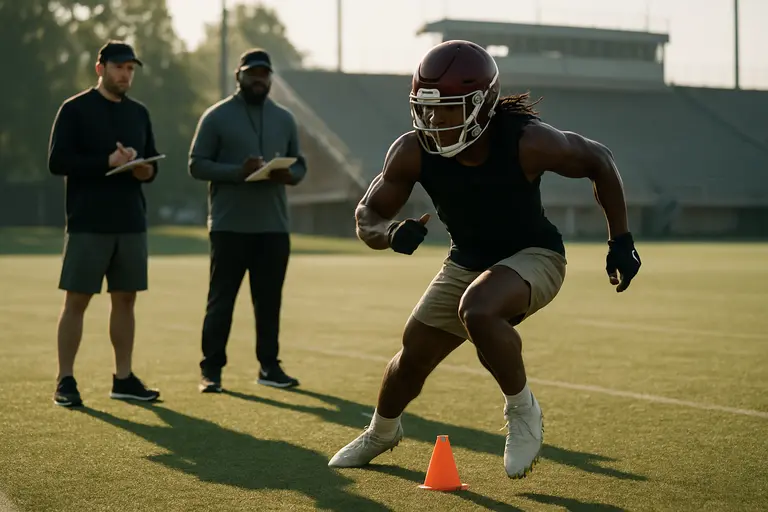
The most encouraging part of Baugh’s opening three games is that the production has come in different forms. The Florida Atlantic game highlighted acceleration and big-play timing. The Campbell game showed another home-run gear with the 75-yard run. The Auburn game supplied the most complete workload profile, with 26 carries and three touchdowns in a conference setting.
Player development is often visible in role stability. Baugh is not waiting for one scripted package. Florida has given him enough carries to set a tone, and he has answered with consistent scoring. Through September 19, 2026, he averaged 8.5 yards per carry across three games. That figure will face tougher tests as opponents adjust, but it is a strong early marker of efficiency.
Scoring Value Beyond Yardage
Eight rushing touchdowns in three games changes how opponents prepare. Yardage moves the ball, but touchdowns finish the work. Baugh scored three times against Florida Atlantic, twice against Campbell and three times against Auburn. That distribution shows repeatable red-zone and open-field scoring value rather than one isolated spike.
The Jadan Baugh impact also reduces pressure on other parts of the offense. A reliable rushing scorer can keep Florida out of desperate passing sequences, help protect leads and give the defense longer breaks between series. Those effects do not require invented advanced numbers; they follow from the way rushing volume and scoring production shape game flow.
What Still Needs Proof
Three games are enough to identify a trend, not enough to settle the full-season ceiling. Opponents will study his cutback habits, preferred run concepts and how Florida blocks for him in short-yardage situations. The next layer of evaluation is how he responds when defenses sell out to limit explosive runs and force shorter gains.
That does not weaken the early case. It keeps the analysis fair. Baugh has already shown burst, workload capacity and scoring touch. The remaining questions are about durability across a full SEC schedule and whether Florida can keep creating enough balance around him so defenses cannot crowd the run game every snap.
What Jadan Baugh impact Means For Florida
The Jadan Baugh impact gives Florida a clear offensive identity point after three games. The Gators have a back with 458 rushing yards, eight rushing touchdowns and a proven ability to create long scores. They also have a player whose 2025 finish against Florida State already showed he could handle a heavy carry count before his 2026 start reinforced it.
For local Florida football readers, the story is not just that Baugh is producing. It is how quickly his role has become central to the Gators’ weekly plan. His September 19 game against Auburn gave the staff evidence that his early numbers could travel into SEC competition. His first two games showed explosiveness. Together, the three performances make him one of the key individual production stories in Gainesville entering the rest of the 2026 schedule.
If Florida keeps building around his strengths without asking him to carry the entire offense alone, Baugh’s production can shape more than box scores. It can influence defensive spacing, play-action opportunities, late-game tempo and the confidence of a new staff. That is why his first three games matter: they show a runner moving from featured talent to weekly foundation.