

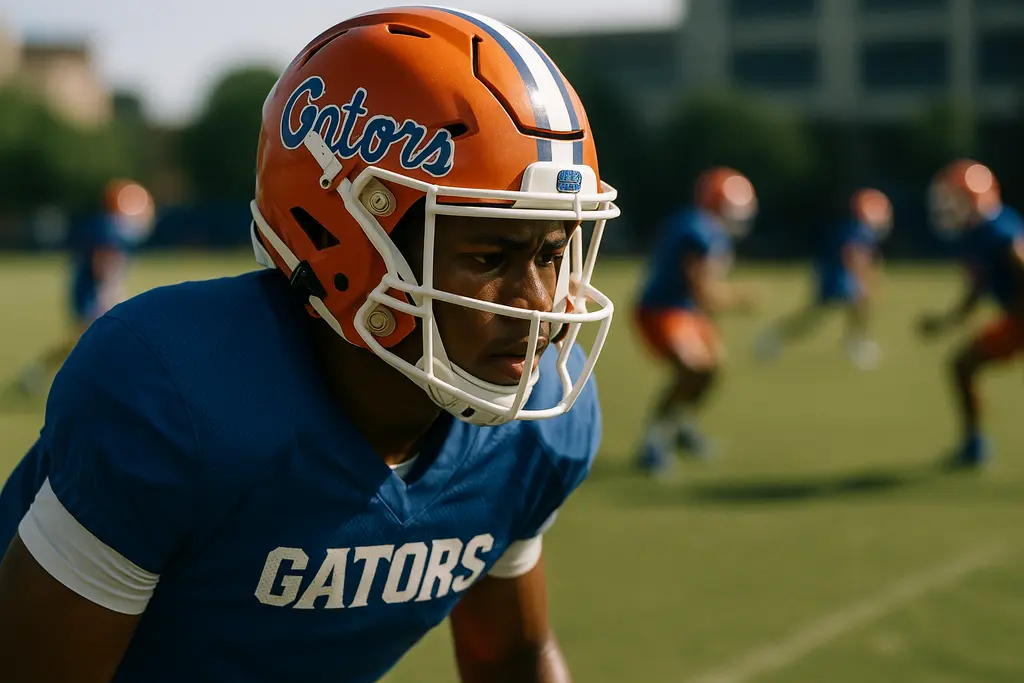
Gators Key Players will define how quickly Jon Sumrall can turn Florida’s 2026 roster from transition mode into a team with stable roles. The names at the top are not just placeholders on a depth chart. They represent the parts of the roster Florida can build around: a returning running back, retained defensive pieces, young receivers, transfer defensive backs, and an offensive line that must protect a new quarterback picture.
The safest way to view this group is through role clarity rather than preseason certainty. Florida has players identified in the research as projected starters, retained core pieces, and transfers brought in to raise competition. That does not lock in snap counts, production totals, or fall-camp outcomes. It does give fans a practical starting point for tracking individual performance once practices and games begin.
Gators Key Players Set The 2026 Starting Point
Gators Key Players In The Backfield
Jadan Baugh is the first name in any Gators Key Players discussion because his role is the easiest to identify from the available reporting. Baugh is a junior returning for the 2026 season and is anticipated to lead Florida’s rushing attack, according to SI’s running back rotation projection. That does not mean Florida has to become a one-back offense, but it does place Baugh near the center of the offensive identity.
For a new staff, a dependable running back can help settle the rest of the offense. The quarterback can work off manageable down-and-distance situations. The offensive line can build rhythm through repeatable run concepts. The receivers can benefit if safeties have to respect early-down run looks. Baugh’s value, then, is not limited to carries. His development in pass protection, ball security, short-yardage timing, and early-down efficiency will shape how much stress Florida removes from the passing game.
What Baugh’s Role Asks Of The Offense
The key is not to assume a fixed workload before camp. The more useful question is whether Baugh can give Sumrall’s staff a reliable base. If he becomes the lead option, Florida can judge the rest of the running back rotation by fit: change-of-pace speed, third-down receiving skill, and late-game physicality. If the line changes around him, his patience and vision become even more valuable. That is where individual production and unit development connect.
Offensive Roles Under Sumrall
Quarterback And Protection Fit
Aaron Philo is listed in the research as a sophomore transfer and as the starting quarterback on a depth chart projection. That listing gives Florida fans a name to track, but it should be treated as a projection rather than a final staff declaration. Quarterback evaluation will depend on timing, decision speed, command of protections, and how well Philo distributes the ball to a receiver group with several different profiles.
The same applies up front. Emeka Ugorji, identified in the research as a sophomore transfer slated at left tackle, carries one of the most visible jobs on offense because left tackle play affects pocket comfort and play-calling freedom. Harrison Moore, listed as a junior transfer at center, has a different but equally important job. Center play is about the snap, calls, communication, and the ability to handle interior movement. If Philo is the quarterback Florida leans toward, the Philo-Moore exchange and pre-snap operation will be worth watching from the first open practice reports through the opener.
For more roster context around how Florida is sorting the position under Sumrall, the site’s quarterback battle context gives a broader view of why the position matters beyond one name on a projected chart.
Receiver Traits To Track
Vernell Brown III, Dallas Wilson, and Eric Singleton Jr. give the passing game three names with different development angles. Brown III is identified as a sophomore and projected key target. Wilson is listed as a redshirt freshman and the starting X receiver. Singleton Jr. is listed as a senior transfer and projected at the Z receiver spot. Those roles matter because receiver labels often point to assignment demands.
The X receiver often has to win outside and deal with press coverage. The Z receiver can be moved, motioned, and used in spacing concepts. A key target such as Brown III may be asked to create separation in high-volume areas of the field, depending on formation and game plan. None of that guarantees production. It does define what to watch: releases, route detail, contested-catch strength, blocking effort, and chemistry with the quarterback.
Defensive Retention Shapes The Rotation
Myles Graham As A Defensive Marker
Myles Graham is one of the clearest defensive names tied to Sumrall’s first roster-building win. The research identifies Graham as one of the five core players retained by Sumrall, and The Independent Florida Alligator reported on Sumrall retaining last season’s group of “fab five” players, including core pieces such as Graham and Jayden Woods in its retention story. For a linebacker, that retention matters because continuity helps with checks, fits, and leadership in the middle of the defense.
Graham’s production should be judged beyond tackle totals once games arrive. Linebackers in a changing program are asked to align the front, fit the run, match backs and tight ends, and communicate coverage adjustments. If Graham handles those responsibilities well, he can make the players around him faster by reducing hesitation. That is the kind of individual role that may not always show up in a basic box score but can affect every defensive series.
Jayden Woods And The Secondary Core
Jayden Woods is another retained core player identified in the research, and his place in the secondary gives Florida a useful piece while the defensive backfield takes shape. Woods’ value is tied to assignment trust. Safeties and defensive backs are often judged harshly because mistakes become explosive plays. A player who knows checks, communicates motion adjustments, and finishes tackles can help a defense avoid cheap yardage.
DJ Coleman adds another storyline. The research identifies Coleman as a transfer from Baylor who committed to Florida in January 2026 and is anticipated to bolster the defensive backfield. The safest read is that he increases competition and gives the staff another option in the secondary. It would be premature to assign him a role beyond that without staff-confirmed usage, but his arrival gives Florida more flexibility as it sorts safety and defensive back combinations.
Florida’s retention picture also fits the broader roster story under the new staff. The site’s look at Gators player retention explains why holding key returners can matter as much as adding transfers during a coaching change.
Depth-Chart Names With Development Stakes
Why Projected Starters Still Have To Earn Roles
Projected depth charts help fans organize the roster, but they are not the same as game-week participation reports. Florida’s projected names give us a framework: Philo at quarterback, Ugorji at left tackle, Moore at center, Wilson at X receiver, Singleton at Z receiver, and Brown as a major passing-game option. The development question is whether those players can turn projected placement into stable roles once competition begins.
For offensive players, the evaluation will be tied together. If the line communicates well, the quarterback can play on time. If the quarterback is on time, receivers can be judged more fairly on separation and catch-point work. If the run game holds up with Baugh leading the way, Florida can avoid asking the passing game to solve every drive. That is why player performance should be watched by role rather than isolated reputation.
- Jadan Baugh: Lead-back traits, pass protection, early-down reliability, and red-zone usefulness.
- Aaron Philo: Command, timing, decision-making, and comfort behind a transfer-shaped line.
- Vernell Brown III, Dallas Wilson, Eric Singleton Jr.: Separation, route discipline, blocking, and quarterback chemistry.
- Myles Graham, Jayden Woods, DJ Coleman: Communication, tackling, coverage fits, and secondary stability.
Where Competition Helps Florida
Competition is not only about replacing players. It can sharpen the players already expected to matter. A transfer at center can raise the standard for communication. A transfer defensive back can push the secondary to be cleaner with assignments. A redshirt freshman receiver listed with the first group can force older players to respond. In a first season under Sumrall, that internal pressure may be one of the clearest signs that the roster is responding.
Why Gators Key Players Matter In 2026
What Fans Should Track From Camp To Kickoff
Tracking Gators Key Players should start with roles, not hype. Baugh’s place in the run game, Graham’s control of the linebacker level, Woods’ steadiness in the secondary, and the transfer pieces around Philo will tell fans more than any preseason label. Florida does not need every projected starter to become a star at once. It needs enough reliable individual play to let the new staff build weekly plans without constantly covering for weak spots.
The 2026 season will give Sumrall’s staff a clearer read on who fits long term. For now, the supported facts point to a roster with retained defensive anchors, a likely lead running back, a projected quarterback, and several transfer or young pieces in high-leverage offensive roles. That is enough to make player development the central storyline in Gainesville before the first real depth chart settles the debate.