

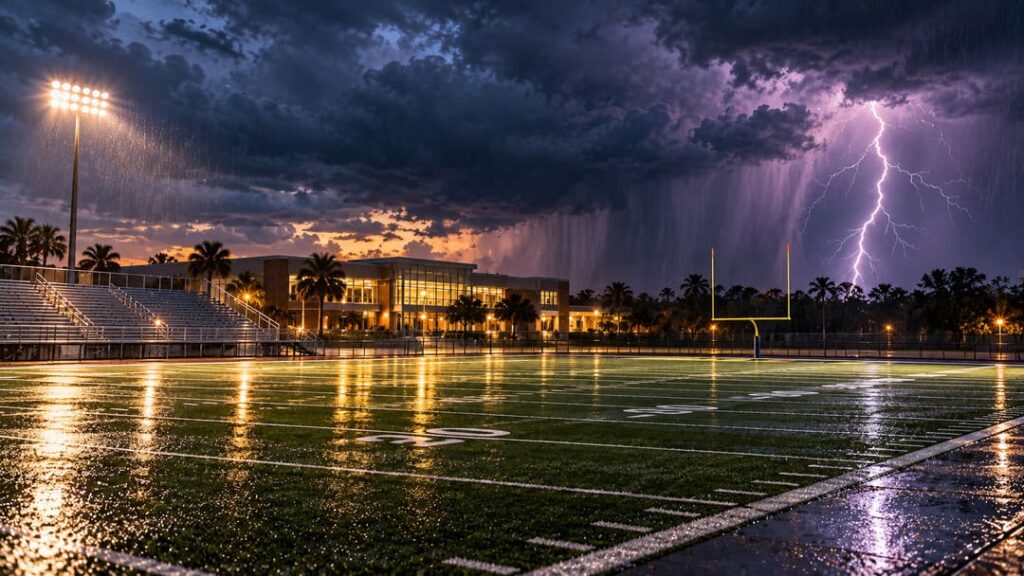
Florida high school football games can be interrupted by lightning even when the field is dry and the storm appears distant. The National Weather Service recommends stopping outdoor activities when lightning is seen or thunder is heard, finding safe shelter and waiting at least 30 minutes after the last thunder before returning outside.
For the broader postseason implications, the site’s 2026 FHSAA playoff structure guide explains the calendar and qualification context.
But a 30-minute wait does not automatically mean the game will resume. School administrators, officials and game organizers must also determine whether conditions are safe and whether the contest can continue.
The 2026–27 FHSAA Handbook explains who has authority over weather-related delays, suspensions and postponements. Its Policy 32 makes student safety the priority and provides procedures that can affect a game’s outcome and scheduling.
How Florida Football Lightning Delays Work
A lightning delay is a safety stoppage, not necessarily a cancellation.
Under the National Weather Service’s outdoor sports safety guidance, organized sporting events should have a designated person monitoring approaching storms, an established communication plan and identified safe shelters.
The agency recommends waiting at least 30 minutes after the last thunder before resuming outdoor activities. If thunder is heard again during the waiting period, that period must begin again.
Consider a hypothetical game stopped at 7:45 p.m. If the last thunder occurs at 8:10 p.m., the earliest return outdoors under that guidance would be 8:40 p.m., provided no further threat develops. That is not a guaranteed kickoff time. Players may still need to warm up, and officials must clear the restart.
Rainfall alone is not a reliable measure of lightning danger. NOAA’s lightning safety recommendations explain that strikes can occur miles from the main storm, including where rain has not yet begun.
During a delay, players and spectators should seek substantial enclosed buildings or hard-topped vehicles with windows closed. Open bleachers, dugouts, picnic shelters and isolated trees are not safe places to wait.
Who Decides Whether a FHSAA Game Continues?
The Florida High School Athletic Association separates immediate weather protection from decisions about a contest’s status.
Under Policy 32.1 of the current handbook, when thunderstorms threaten an outdoor contest, officials must contact the principals or designated representatives of the competing schools.
For contests outside the FHSAA State Championship Series, officials must honor a request from either school’s principal or designee to interrupt or postpone the game. An official cannot reject such a weather-safety request or suggest that the school will automatically forfeit.
State championship events operate differently. The FHSAA administrative staff, finals host and officials manage inclement-weather situations under the association’s procedures.
A suspended contest ordinarily resumes from the point where it was interrupted, unless applicable NFHS or FHSAA rules determine that the contest is already complete.
This distinction matters because a lightning delay does not erase everything that happened before the stoppage. Neither does it guarantee that a game can be completed the same evening.
Why Weather Postponements Matter More Near the Playoffs
October creates additional scheduling pressure for Florida high school football.
The FHSAA’s official 2026 football calendar establishes two important deadlines:
- October 23: Last allowable district playing date.
- October 30: Last allowable regular-season playing date.
Those dates make a postponed late-season matchup more complicated than moving an early September game.
Policy 13.2.3 of the FHSAA Handbook allows the executive director to grant permission for certain weather-postponed contests to be played after a deadline, provided the contest was originally scheduled before that deadline.
However, the handbook also states that team-sport contests played after applicable FHSAA calendar deadlines are not included in team rankings for seeding purposes.
That means permission to complete a postponed game and whether its result affects playoff rankings are separate questions.
Florida-football.com’s coverage of storm-related schedule changes in Northeast Florida shows how weather can shift games to different nights and disrupt school operations.
What Families Should Do During a Delay
For families attending a Florida high school game, the immediate priority should be finding proper shelter rather than waiting near the field for an announcement.
Before leaving home, check the host school’s athletic department for updates on kickoff time, venue and ticket arrangements. During the event, follow official evacuation instructions and avoid relying solely on social media speculation about when play will restart.
If a game is postponed, confirm the replacement date and location directly with the school. Previously purchased tickets, transportation arrangements and event schedules may require separate clarification.
The central lesson is simple: A lightning delay protects players, coaches, officials and spectators. The 30-minute safety guidance helps establish when returning outdoors may be appropriate, but FHSAA procedures and actual weather conditions determine what happens to the football game.