

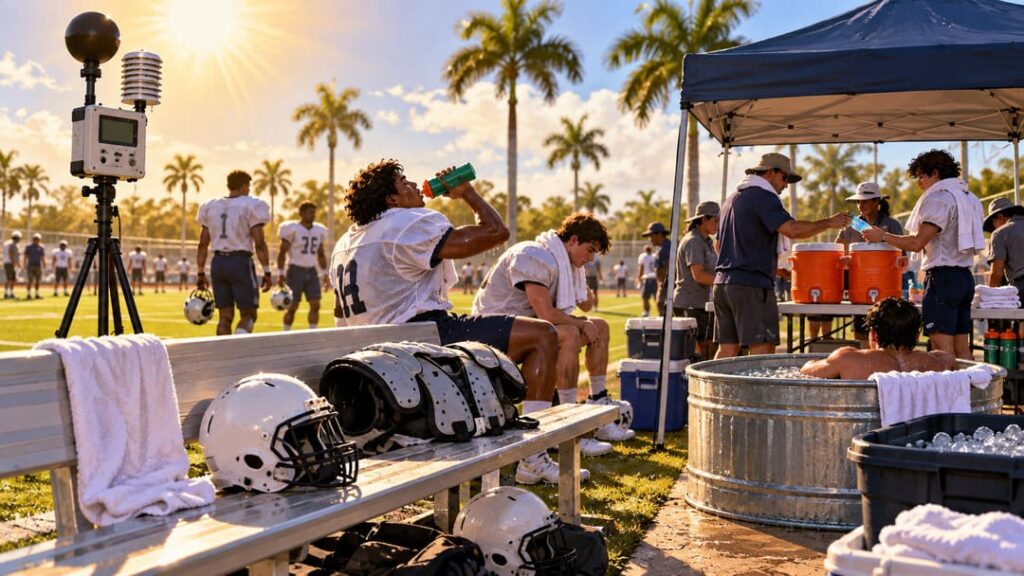
An outdoor Florida high school football practice must stop at a wet-bulb globe temperature (WBGT) reading of 92.1 degrees Fahrenheit or higher. But that same reading does not automatically cancel a game. Florida’s rules use different heat restrictions for practices and contests, and they leave room for school officials to delay or postpone a game when conditions are unsafe.
That distinction is explicit in Policy 41 of the 2026-27 FHSAA Handbook. For players and families, the useful question is not simply how hot a weather app says it feels. It is what the on-site WBGT reading shows, what kind of activity is taking place, and what the school is doing in response.
Why WBGT Matters More Than the Weather-App Heat Index
WBGT measures heat stress during physical activity by accounting for air temperature, humidity, sunlight and wind. The familiar heat index mainly combines air temperature and humidity and assumes shade. As the National Weather Service’s Tampa Bay heat guidance explains, those measurements answer different questions. A phone’s heat-index number is therefore not a substitute for the field-level WBGT reading used in FHSAA decisions.
Under the handbook, schools monitor conditions using a WBGT device, with readings required when WBGT is reasonably expected to exceed 82 degrees Fahrenheit. The device should be allowed to adjust to the venue before activity, positioned in the sun, and checked approximately every 30 minutes during the practice or event. If the reading moves into a more restrictive range, the required precautions change with it.
The Heat Limits for Florida Football Practice
The FHSAA’s practice requirements become progressively stricter as WBGT rises:
- 82.1–87.0 degrees Fahrenheit: At least three separate four-minute rest breaks per hour.
- 87.1–90.0 degrees Fahrenheit: At most two hours of activity and four separate four-minute rest breaks per hour. Football players are limited to helmets, shoulder pads and shorts, with an exception for those already practicing in football pants when the reading rises.
- 90.1–92.0 degrees Fahrenheit: At most one hour of activity, five separate four-minute rest breaks, no protective equipment and no conditioning activities.
- 92.1 degrees Fahrenheit and higher: No outdoor activities.
These are WBGT readings, not ordinary air temperatures or heat-index values. The index applies to preseason practices and to in-season practices when environmental conditions are dangerous. School staff must also watch individual warning signs; being below a threshold does not prove that every athlete can safely continue.
The handbook also defines a 14-calendar-day heat-acclimatization period for each athlete, including players who join after teammates have begun. For football, the first two practice days permit helmets only; days three through five can add shoulder pads with shorts; full gear and deliberate body-to-body contact are permitted beginning on practice day six. A late-arriving player does not skip that progression simply because the team has already played games. Football players must complete six practice sessions before entering a contest, while the longer acclimatization period still governs their practice workload and recovery.
Why Game-Day Heat Breaks Follow a Different Schedule
For an actual football contest, the handbook sets hydration breaks rather than repeating the practice-duration limits. At WBGT 82.1–87.0 degrees Fahrenheit, there must be at least one two-minute rest break per quarter. At 87.1–90.0 degrees Fahrenheit, teams must take a three-minute hydration break at or near the six-minute mark of each quarter, with helmets removed. At 90.1 degrees Fahrenheit or higher, the rule calls for three-minute hydration breaks at or near the eight-minute and four-minute marks of every quarter, again with helmets removed. For the higher two bands, coaches may not enter the field during these breaks.
That is not a guarantee the game will continue. The FHSAA allows further safety measures, including altered start times, added shade and cooling, or postponement. Outside FHSAA State Championship Series events, if either school’s principal or designated representative requests a delay, interruption or postponement because of oppressive heat demonstrated by an official WBGT reading, game officials must honor it. They cannot threaten a forfeit for that safety request. State Finals have separate FHSAA event-management authority.
A crucial consequence follows: an outdoor practice can be prohibited at 92.1 WBGT while a scheduled contest falls under the game’s hydration-break and administrator-decision procedures. Parents should not assume the practice cutoff is automatically a game cancellation rule, or that the absence of a cancellation means conditions are harmless. If a heat delay changes the football schedule, the site’s 2026 FHSAA football calendar guide provides context for regular-season and postseason dates. A separate lightning-delay explainer covers storm-related stoppages, which use different safety procedures.
The Cooling Plan Matters as Much as the Breaks
Florida law requires more than water on the sideline. Under Florida Statutes section 1006.165, FHSAA member schools must monitor heat, modify activities and provide rapid-cooling capacity, including cold-water immersion or equivalent means and trained personnel. Emergency action plans must include on-site cooling before hospital transport in a suspected exertional heat-stroke emergency. Emergency services should be activated immediately; trained responders should not delay rapid cooling while waiting for transport.
The CDC’s guidance for athletes in hot weather advises players who feel faint or weak to stop activity and move somewhere cool, and to seek medical care promptly for heat-illness symptoms. Confusion, collapse or suspected heat stroke requires an emergency response, not a wait for the next scheduled water break.
For families, the most useful questions to ask a host school are practical: Who takes the WBGT readings, where is the rapid-cooling equipment, who is trained to use it, and how will families be told if the start time changes? A forecast can help everyone prepare, but the school’s measured conditions and safety plan determine the next step.