

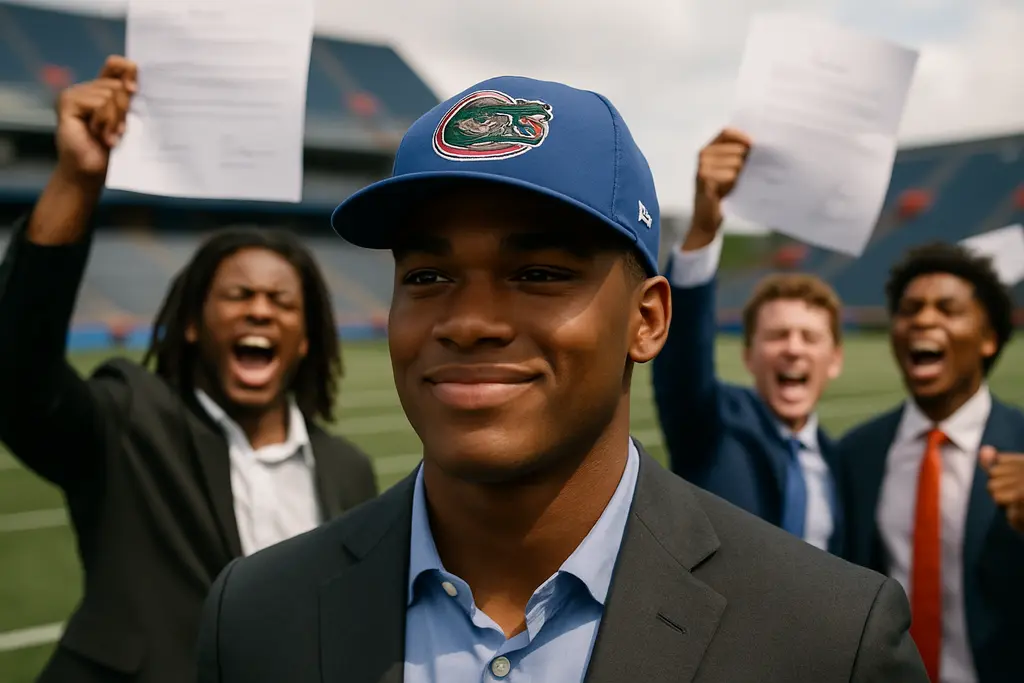
Florida Gators signees from in-state high schools gave Jon Sumrall’s program a clear local thread across the 2026 signing class and the early 2027 board. As of October 5, 2026, the verified picture is not about guesses on stars or depth-chart promises. It is about where the players came from, what roles they were recruited to fill, and how Florida has continued to use Gainesville, Tampa Bay, Orlando, Fort Lauderdale, Lakeland and South Florida as roster-building ground.
The 2026 class brought local pieces at quarterback, wide receiver and along the offensive line. The 2027 group added skill speed, a defensive lineman with a late-start football background, and a cornerback with production in multiple defensive categories. That mix matters because Florida has to balance portal work with high school development. Local signees and commitments do not guarantee fast snaps, but they can raise practice competition and help the staff build position rooms with players already used to Florida high school football.
Florida Gators signees In The 2026 Class
Florida Gators signees On Offense
Florida’s official 2026 National Signing Day roster listed several in-state additions, including quarterback Will Griffin from Jesuit Senior High School in Treasure Island, wide receiver Justin Williams from Buchholz High School in Gainesville, offensive lineman G’Nivre Carr from IMG Academy in Ocala, and offensive lineman Chancellor Campbell from Lakewood in St. Petersburg official 2026 signing roster. Those listings provide the firmest baseline for the class: position, size, school and home-state connection.
Griffin was listed at 6-foot-3 and 230 pounds, giving Florida a local quarterback prospect with a college-ready frame. For any quarterback signee, the early path usually depends on scheme command, timing with receivers and protection calls rather than size alone. Griffin’s value to the room begins with developmental reps and competition. The staff does not need to rush the evaluation beyond what the roster allows.
Williams, listed at 5-foot-10½ and 187 pounds, stayed close to home after playing at Buchholz in Gainesville. That local angle carries weight for Florida fans because Gainesville-area players rarely need an introduction to the demands around the program. A receiver from the city also gives the staff a direct example to use with nearby schools: there is still a path from local Friday nights to the Gators’ receiver room.
Line Depth From Tampa Bay And IMG
Carr and Campbell give the 2026 group much of its local size. Carr was listed at 6-foot-4¼ and 309 pounds out of IMG Academy. Campbell was listed at 6-foot-7½ and 307 pounds out of Lakewood in St. Petersburg. Those body types point to a clear priority: Florida needed high school offensive linemen with length and mass who could develop inside the program rather than relying only on short-term roster fixes.
| Player | Position | Florida High School | Listed Size |
|---|---|---|---|
| Will Griffin | Quarterback | Jesuit Senior High School | 6-3, 230 |
| G’Nivre Carr | Offensive Line | IMG Academy | 6-4¼, 309 |
| Justin Williams | Wide Receiver | Buchholz High School | 5-10½, 187 |
| Chancellor Campbell | Offensive Line | Lakewood | 6-7½, 307 |
This group of Florida Gators signees also fits a broader roster idea: keep skill talent near Gainesville, keep working Tampa Bay and Pinellas County, and keep a presence around national programs located inside the state. Fans tracking how local recruiting connects with depth can compare this class with prior in-state work in our breakdown of how the Gators recruiting class keeps Florida roots.
Florida Gators signees And The 2027 Board
Elias Pearl’s Production Profile
The 2027 group of Florida Gators signees and commitments showed a different type of local emphasis: perimeter production. Elias Pearl from Port Charlotte committed on May 19, 2026. During his 2025 junior high school season, he caught 69 passes for 1,052 yards and 13 touchdowns. He also carried the ball 40 times for 253 yards and 11 touchdowns. Those numbers point to a player who was used as both a receiving target and a backfield option.
Pearl’s profile is useful because Florida can evaluate him through volume, not just traits. A player with that many touches had to handle defensive attention, weekly usage and multiple alignment demands. That does not lock him into a college role, but it gives the staff film from different situations: screens, vertical routes, run-game touches and red-zone chances.
Anthony Jennings And Vertical Speed
Anthony Jennings from Dillard High School in Fort Lauderdale committed on April 25, 2026. His junior-year production included 34 receptions for 823 yards and 11 touchdowns. That yardage-to-catch profile points to explosive-play usage. Florida has often looked to South Florida for receivers who can stretch a defense, and Jennings fits that type based on the verified production provided.
The important caution is role projection. High school explosive plays do not automatically carry over to SEC snaps. Timing, route detail and blocking all matter once a receiver enters a deeper college room. Still, Jennings gives Florida a speed-oriented option from a Broward County program, which keeps the staff active in one of the state’s most important recruiting areas.
Defensive And Line Development Paths
Keumajou’s Late-Start Profile
Stive-Bentley Keumajou, a defensive lineman from Coral Gables, committed on May 6, 2026. On3’s rundown of Florida’s 2027 class noted that he arrived from the United Kingdom, played only one high school football season before earning offers, and had track and field work in discus, shot put and javelin On3 2027 class report. That background makes him one of the more interesting developmental evaluations in the local group.
For a defensive lineman, limited football mileage can be read two ways. It means there may be technique work ahead, especially with pad level, hand use and snap recognition. It also means the physical ceiling may not be fully defined yet. His throwing-event background gives the staff another athletic data point without needing to inflate the projection beyond what has been reported.
Whitfield And Morris Add Defensive Production
Kamauri Whitfield, a cornerback from The First Academy in Orlando, committed on July 6, 2026 after previously being committed to Tennessee. His junior season included 52 tackles, seven tackles for loss, two sacks, one forced fumble, one recovered fumble and five quarterback hurries. That production suggests a defensive back who was used near the ball, not only as a coverage piece.
Malik Morris, a four-star linebacker from Lakeland High School, committed in July 2025. He recorded 95 tackles, nine sacks and three forced fumbles, while also adding five rushing touchdowns for a team that finished 13-1 and reached the Florida 5A state title game. That two-way contribution matters because Lakeland football has long tested players in physical games. For Florida, Morris’ verified production points to a linebacker who was trusted to affect games in several ways.
The defensive group is not just about one position. Whitfield gives the staff a central Florida defensive back. Morris represents Polk County linebacker production. Keumajou gives the board a South Florida defensive line development case. Together, they show why local recruiting cannot be measured only by who might play first. Some players are floor raisers in practice. Others need time, weight-room work and position coaching before their best football appears.
What Florida Gators signees Mean For Florida
For Florida Gators signees, the local pathway carries practical value. Families can reach Gainesville without cross-country travel. High school coaches across the state can see direct evidence of recruiting follow-through. Fans get a clearer connection between Friday-night football and the college roster they follow on Saturdays.
The roster effect is still conditional. Griffin has to grow within the quarterback room. Williams, Pearl and Jennings have to turn high school production into college consistency. Carr and Campbell have to develop against SEC defensive fronts. Whitfield, Morris and Keumajou have to translate their production or traits into defined defensive jobs. None of that is automatic.
What is clear, as of October 5, 2026, is that Florida’s recent recruiting updates carried a strong in-state spine. The 2026 signees gave the program local size and offensive skill. The 2027 commitments added speed, defensive range and developmental upside. For a program trying to build under Jon Sumrall, that is the point: keep more Florida prospects connected to Gainesville, then let coaching, competition and roster need determine who becomes the next early contributor.