


This resource gives a weekly update on player health in Florida’s major sports. It focuses on clear updates about who’s playing and who’s recovering.
The reports follow a structured system, like the Florida Workers’ Compensation System. This ensures timely and accurate information.
Information comes from official sources. This means we focus on facts, not guesses.
Our aim is to provide a trustworthy source for player status updates. This helps fans, analysts, and the sports world understand team performance better. We offer weekly updates with objective data.
What Fans Can Reliably Know: reports, coach quotes, practice notes, privacy limits
Fans looking for the latest on player health have a trusted source list. This list sorts out rumors from facts. It’s all about getting the real scoop on injury status.
The top source is the official injury report. Teams must file these reports, listing who’s hurt and when they might play. This report is the official word on who’s in and who’s out.
After games and practices, coaches and trainers share important details. They talk about how serious an injury is and when a player might return. Their words help fans understand the official injury status better.
Reporters at practices give fans a sneak peek. They note who’s practicing and how hard. This tells fans about practice participation, from a little to a lot.
The table below shows the main sources and what they offer.
| Information Type | Primary Source | Typical Detail Provided | Reliability Level |
|---|---|---|---|
| Official Injury Report | Team (to League) | Player name, injury body part, practice status (Out, Limited, Full) | Highest (League-mandated) |
| Coach/Trainer Quotes | Post-practice/media sessions | Context on severity, recovery progress, general timeline estimates | High (Official spokesperson) |
| Practice Observations | Credentialed media | Visual confirmation of participation, drill involvement, equipment worn | High (Direct observation) |
| Team Medical Statement | Official press release | Formal updates on surgical procedures or long-term recovery milestones | Highest (Official statement) |
Privacy laws and ethics set limits on what teams can share. They keep things like medical images and detailed diagnoses private. This is like how employee health info is kept secret in other fields.
Teams act like employers, getting updates from their doctors. This means fans get info like “limited in practice,” not the full medical file. It keeps player health private while sharing what fans need to know.
These sources—official reports, coach comments, and practice notes—make up the reliable info for fans. Knowing this helps fans understand who’s playing and who’s not. It helps fans tell real news from rumors.
Weekly Timeline: postgame nicks → Mon estimates → Thu availability → Gameday status
Injuries in sports follow a weekly plan set by leagues and teams. This plan helps fans and experts understand when players might return. It turns early guesses into clear game-day plans.
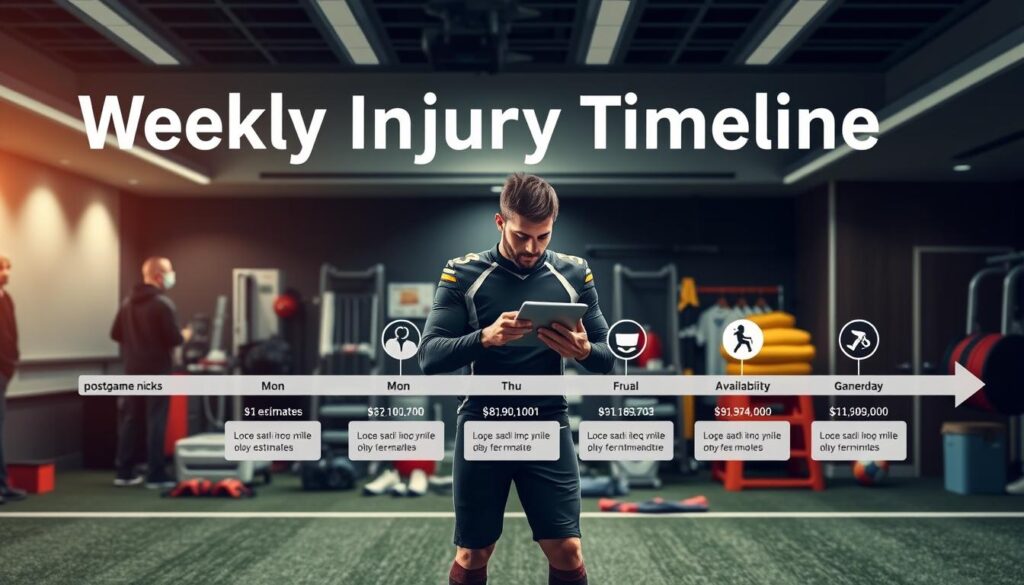
Right after a game, coaches talk about “nicks and bruises.” These comments hint at possible injuries but don’t give details. They’re the first sign of trouble.
By Monday, teams start to give more serious updates. They check on players and share who might practice. This is like a formal report in other jobs. Monday marks the start of the week’s injury news.
Thursday is when we get the most important news. Who practiced and who didn’t helps figure out who will play. Players are labeled as out, doubtful, questionable, or probable.
The questionable and probable labels are key. They tell us who might be in the game. Thursday’s report gives us the best guess before the game.
On game day, teams confirm who’s playing and who’s not. This is the final say on a player’s status. Even if someone is probable on Thursday, they can be out on game day.
This weekly cycle helps fans understand injury news better. Early hopes can change, and late-week news is more reliable. It’s a way to balance secrecy with clear updates. This timeline is key for injury analysis in Florida sports.
Impact by Position Group: QB, OL, WR/TE, RB, DL, LB, DB, specialists
In football, injuries affect each position differently. This is like how injuries in other jobs impact specific tasks. The effect of an injury on a team is not the same for all positions.
The table below shows how injuries change each unit’s strategy. It highlights key weaknesses, how players adjust, and expected changes in how often they play.
| Position Group | Primary Impact on Game Plan | Typical Depth Chart Moves | Effect on Snap Counts |
|---|---|---|---|
| Quarterback (QB) | Changes the team’s offense and playbook. Limits long passes and quick changes in plays. | Backup QB becomes the starter. A third QB might be brought up from the practice squad. | The starter gets no snaps. The backup plays every snap on offense. |
| Offensive Line (OL) | Weakens protection against passes and run plays. Tight ends or running backs might help more. | The next lineman in line plays. This often means changes across the line. | Backup linemen play more. The team might rotate players to avoid fatigue. |
| Wide Receiver / Tight End (WR/TE) | Reduces the variety of plays and options in the red zone. Limits the team’s advantages. | The next WR/TE up gets more playing time. A practice squad player might get a chance. | Secondary receivers get more targets and snaps. Using two tight ends might happen less. |
| Running Back (RB) | Narrows the playbook. Affects short-yardage and screen plays. | The team might use a committee approach. A third-down back might get more carries. | Snaps are spread among the remaining backs. A clear backup might emerge. |
| Defensive Line (DL) | Weakens the pass rush and run defense. More blitzing is needed. | A rotational edge rusher or interior tackle starts. They replace an injured player. | Players are rotated more to keep them fresh. Backup linemen play a lot more. |
| Linebacker (LB) | Weakens run defense and pass coverage. Changes how the defense calls signals. | The next linebacker plays. A safety might become a hybrid “moneybacker.” | The core special teams linebacker plays defense. The starters might play every down. |
| Defensive Back (DB) | Changes the defensive coverage. Can expose a side or the slot receiver. | A nickel or dime back becomes a starter. They replace a corner or safety. | Backup defensive backs play more. The team might use fewer sub-packages. |
| Specialists (K, P, LS) | Directly affects scoring and field position. Field goals, PATs, punts, and kickoffs are impacted. | Emergency signings are common. A player might handle kickoffs or holding duties. | Specialist snaps are low but critical. The backup handles all specialist duties. |
This breakdown shows why analyzing an injury report is complex. A quarterback change changes everything. A defensive back injury might only affect specific packages. Understanding these impacts helps predict depth chart moves and snap counts.
Depth Chart Fallout: backups, package changes, special teams shifts
When a player gets hurt, the first thing that changes is the depth chart. The next player up gets to start. This is just the beginning of the depth chart moves needed to keep the team running smoothly.
One player’s injury creates a ripple effect in the team. The backup moves up to the first team. Then, the second team gets a new player, and so on. Sometimes, a player from the practice squad is called up to add more depth. Every move is tracked and shared with the whole team.
Coaches adjust their plans based on the new player’s strengths. For example, if a tackle is out, the offense might use more passes. Defensive coordinators might simplify their calls if a key safety is missing. These changes are made to fit the new player, not to change the team’s overall strategy.
Special teams units also see big changes. Players from offense and defense often join these teams. When a key player is out, special teams coordinators have to find new players. This can change the team’s speed, strength, and experience.
These adjustments are how teams deal with injuries. They are the depth chart moves that help teams stay competitive. The aim is to keep everything running smoothly, even with new players.
Recovery Windows: Typical Timelines (Non-Medical, Historical Ranges)
Return-to-play timelines for common athletic injuries show clear patterns across sports. These historical ranges help us understand how long players might be out. They’re based on data from past cases, not individual medical advice.
Recovery times differ a lot based on the injury and the person. Minor issues might heal in weeks. But severe injuries can take months or even years to fully recover.
The Maximum Medical Improvement (MMI) is a key milestone. It’s when an athlete is fully healed and ready for full contact.
Historical data gives us general estimates for how long players might be out. The table below shows typical recovery times for common football injuries.
| Injury | Typical Historical Recovery Range | Notes |
|---|---|---|
| Minor Ankle Sprain | 1 – 3 weeks | Often involves ligament stretching without a full tear. |
| Hamstring Strain (Grade 2) | 2 – 6 weeks | Timeline depends heavily on the grade of the muscle tear. |
| Shoulder Dislocation | 3 – 6 weeks | Return often hinges on stability and regaining full range of motion. |
| Concussion | 1 – 3 weeks | Protocols are strict; recovery is highly individualized. |
| Torn ACL | 9 – 12 months | This represents the historical range for return to competitive play. |
These timelines are just general guides. They don’t consider an athlete’s unique body or the latest in rehab. The legal concept of Temporary Total Disability, which can cover up to 104 weeks, shows how recovery can vary a lot.
Fans should keep these historical ranges in mind when setting expectations. For the latest Gators injury updates, always check the team’s official reports. Official communications are the only reliable source for a player’s status and return date.
Snap Count Forecasts: pitch counts and situational usage
Football teams use snap counts to help players coming back from injury. They limit how many plays a player can make. This helps control how much they work and helps them get back in shape.
A snap count is like a safety net against getting too tired or hurt again. Doctors and coaches decide how many plays based on the player’s current health. It’s like when someone comes back to work with certain limits.
There are many things that help figure out these limits. Reports from practice and what coaches say about a player’s role are important. Also, how similar injuries were handled in the past helps. All these help make a good guess about how much a player will play each week.
How a player is used in the game is just as important as how many snaps they get. Coaches plan special roles for players coming back. For example, a defensive back might only play in certain situations. A wide receiver might run certain types of routes that don’t require quick cuts.
Common roles include:
- Offensive linemen playing only in heavy run-blocking sets.
- Running backs being used solely as third-down pass protectors.
- Linebackers entering the game only in base defensive formations.
- Specialists, like kick returners, having their touch count monitored.
These plans can change during the game. If a player does well in the first half, they might play more in the second. But if they look tired, they might stop playing sooner. Knowing about snap counts and how players are used helps us understand their role when they come back.
Matchup Lens: how injuries affect next opponent’s strengths
Looking at injuries through the lens of the next opponent’s strengths changes how we view them. A player’s absence is not just a concern. It’s about the specific challenges the upcoming game poses.
An injury status report lists who’s out. But its real meaning comes when we look at the opponent’s strengths. The opponent’s strong points tell us which matchups are most important.
This analysis is all about facts. It looks at the advantages or disadvantages of an absence. The focus is on the team’s capabilities, not guesses.
For example, losing a top cover cornerback is big if the next opponent has a great wide receiver. We’d look at the receiver’s recent performance and the quarterback’s passing skills.
On the other hand, losing a defensive tackle who stops the run is more important against a team with a strong running game. We’d check the opponent’s yards per carry and success in short-yardage situations.
Every position group faces a specific opponent strength. A quarterback’s mobility issues are key against a strong pass rush. Losing an offensive lineman is critical against a team that loves to blitz.
The table below shows how injuries change matchup dynamics. It helps us evaluate objectively.
| Injured Position | Opponent Strength | Key Matchup Impact | Strategic Consequence |
|---|---|---|---|
| Primary Slot Cornerback | High-volume short passing game | Increased vulnerability over the middle; more completions on third down. | Opponent may sustain longer drives, controlling time of possession. |
| Pass-Rushing Defensive End | Offensive line with protection issues | Reduced quarterback pressure; more time for deep routes to develop. | Opponent’s play-action and vertical passing game becomes more effective. |
| Feature Running Back | Defense weak against the run | Loss of a primary ball-carrier against a favorable front. | Offense may become one-dimensional, increasing pass protection pressure. |
| Deep Safety | Offense with explosive pass plays | Loss of the last line of defense against vertical threats. | Defensive scheme may need to shift, potentially opening other areas. |
This analysis goes beyond just saying a player is out. It gives context to the injury status. It helps fans and analysts see how absences can affect the game.
Looking at recent games and stats is key. What plays does the opponent run best? What personnel do they use in key situations?
An accurate injury status is the first clue. The opponent’s strengths are the second. Together, they show us the matchup challenges ahead.
Late Breaking vs. Official: how to verify day-of info responsibly
It’s important to know the difference between confirmed news and rumors. The hours before a game are filled with rumors. But, we should only believe in news that’s confirmed.
Official team channels are the only ones we can trust. This includes the official inactives list, press releases, and verified social media. These are the final words.
Late-breaking reports often come from unverified sources. If a player’s status changes suddenly, we need to check it against official sources. We should also look at updates from trusted reporters.
Beat reporters with direct access to the team are very reliable. They share insights from practice participation and locker room talks. But, we should wait for the official inactives list to confirm their reports.
| Source Type | Reliability Level | Recommended Action |
|---|---|---|
| Team-Issued Inactives List (NFL) | Definitive / Official | Accept as final status. No further verification needed. |
| Official Team Press Release | Definitive / Official | Accept as final status. Cross-post with official social media. |
| Credentialed Team Beat Reporter | High / Unofficial | Use for early indication, but await official list for confirmation. |
| Non-Credentialed “Insider” Account | Low / Unofficial | Requires cross-verification with at least two higher-level sources. |
| Fan Forum or Message Board Rumor | Very Low / Unofficial | Discard until confirmed by an official or high-reliability source. |
This process is like resolving disputes. We need solid evidence for injury reports. Waiting for official news is the best way to be sure.
Watching midweek practice participation reports helps us understand game-day status. A player who was limited all week is more likely to be scratched. This information helps us judge rumors.
Fans should trust sources in order. Official team communications are first. Then, trusted journalists. We should only believe in news that matches these sources. This way, we avoid believing in rumors.
Fan Checklist: alerts to set before kickoff
Staying ahead of injury news is key. Fans should find reliable sources before the game.
Follow official team accounts on X and Instagram. Also, add trusted local beat reporters to your list. They often share the first updates from practice and press conferences.
Bookmark the official team website’s news section. Check the weekly game notes before each game. These notes have injury updates and depth chart changes.
Know the roster terms. “Injured Reserve” (IR) and “Physically Unable to Perform” (PUP) mean players are out for a long time. The NCAA’s medical redshirt rule lets players keep their eligibility after a season-ending injury early in the year.
The medical redshirt rule is like long-term absence systems in other fields. It’s for players needing a lot of time to recover, like in vocational rehab programs.
Set notifications for key reporters and team accounts. This way, you get updates on gameday inactive lists or last-minute changes. Trust these verified sources over rumors on social media.
This checklist helps you stay active in following the game. Informed fans can predict lineup changes and their game impact.