

Welcome to the coaching carousel analysis. Here, we dive into Florida’s staff changes with the skill of a surgeon and the humor of a late-night comedian.
I’ve been keeping a close eye on these coaching staff announcements. The Billy Napier era is turning out to be quite interesting.
Is it a smart move to build a program, or a sign of too much? Napier came to Gainesville with a big team.
This isn’t just adding a few new faces. It’s building an empire, with titles that sound more like a big company. It’s like something Caesar would have done.
What does this big change mean for the Florida Gators? Let’s explore the most exciting organizational shift in college football.
Staff Tracker: current roles, new hires, departures
The term ‘coordinator changes’ doesn’t quite capture the strategic overhaul happening in Gainesville. This is a full-blown organizational re-architecture. It feels less like a simple promotion and more like Billy Napier designing his own football version of the corporate ladder.
Let’s start with the headline act. Ron Roberts isn’t just a new defensive coordinator. He’s been anointed the Executive Head Coach for Defense. This title sounds like it belongs in a Silicon Valley tech firm, not a football field. His mandate? To be the defensive godfather, the OG who oversees the entire scheme while “coaching the coaches.”
This creates a fascinating, almost meta, chain of command. Jay Bateman remains the official defensive coordinator, calling plays on game day. But he now reports up through Roberts, who reports to Napier. It’s a coaching inception—a coordinator within a coordinator. This layered approach is Napier’s answer to modern football’s complexity. Why have one brilliant defensive mind when you can have two, stacked neatly like a Russian nesting doll?
Then there’s the front office maneuver. Mark Robinson, a name familiar to NFL salary cap enthusiasts, has been brought into the fold. His role is that of a college football salary cap manager, navigating the brave new world of NIL collectives and transfer portal economics. His hiring signals that Florida is playing chess, not checkers, in the roster management game.
These high-profile moves are just the tip of the iceberg. They exemplify Napier’s now-famous philosophy: “if it ain’t broke, add more coaches—and analysts, and support staff.” The Gators’ football support staff has ballooned to a reported 64 non-coaches. To put that in perspective, some FBS teams don’t even dress 64 players for a game. Florida has built a support army.
| Name | New Role | Previous Role | Strategic Impact |
|---|---|---|---|
| Ron Roberts | Executive Head Coach, Defense | Defensive Analyst, Florida | Adds a top-level strategist; creates a dual-layer defensive brain trust. |
| Jay Bateman | Defensive Coordinator | Co-Defensive Coordinator, Florida | Retains play-calling duties but gains a senior mentor, potentially freeing him to focus on tactics. |
| Mark Robinson | Director of Player Personnel & NIL Strategy | Front Office Executive, Atlanta Falcons | Brings pro-style roster and financial management to the NIL/Portal era. |
| Support Staff Corps | Various Analyst & Quality Control Roles | N/A (Expanded Group) | Provides unprecedented data, prep, and developmental bandwidth; the program’s “shadow cabinet.” |
So, what’s the net result of all these coordinator changes and hires? It’s a deliberate shift from a traditional coaching hierarchy to a modern, corporate-style matrix. Napier isn’t just filling vacancies. He’s building an institution. Each hire, from the executive defensive coach to the army of analysts, is a piece in a larger puzzle designed to out-prepare and out-innovate the competition.
The departure side of the ledger has been relatively quiet, which is telling. The major coordinator changes have been additive, not subtractive. This isn’t a tear-down. It’s an aggressive build-up, a bet that more brainpower and specialization will translate directly to more wins in the brutal SEC. Only the scoreboard will tell if this unique staff tracker leads to a championship tracker.
Why the Move: context and official statements summary
Why did the Florida team make a sudden change on the sideline? It’s not just about what was said. It’s what was clear on the field last fall.
Billy Napier’s words at the postseason press conference were carefully chosen. He didn’t say “our defense was a disaster.” Instead, he talked about needing a better performance on defense. He mentioned needing new leadership and a fresh voice.
He talked about needing a different approach in recruiting and a new teacher for the defense. This means the defensive performance was a big problem. The scheme tendencies were so obvious, it felt like cheating for opposing teams.
The real story is clear. Florida ranked 7th in the SEC in scoring defense last season. In a league where defense wins championships, this was a major issue. Napier’s words were like saying “it’s not you, it’s me” to his staff. But the message was clear: results weren’t good enough.
Let’s break down what was said versus what was meant.
| Official Statement (The Spin) | Likely Reality (The Context) |
|---|---|
| “We need a new voice and new leadership on defense.” | The existing scheme tendencies had grown stale and predictable. Players needed a fresh philosophical approach and teaching method. |
| “A different approach in recruiting for that side of the ball.” | The previous staff struggled to identify, land, and develop the elite defensive talent required to compete in the SEC’s brutal weekly slate. |
| “We simply have to play better on that side.” | Finishing 7th in conference scoring defense is an untenable position for a program with championship aspirations. The unit was a statistical weak link. |
In the end, the reason is clear. Billy Napier looked at the film and the standings. He decided the defensive performance needed a new direction. The official statements were polite, but the stats told the real story.
Scheme Ripples: offense/defense/special teams tendencies to expect
Forget small changes; the latest position coach updates bring big shifts in the Gators’ game plan. It’s not just tweaking. It’s a complete overhaul, introducing new strategies the SEC hasn’t seen before.
On offense, expect a focus on running the ball with power. The use of two tight ends on many plays shows the team’s physical intent. It’s like building a strong line of scrimmage, opening up space for Trevor Etienne to run. Anthony Richardson will have clearer plays, making his job easier.
Defensively, the team is getting more complex with Sean Spencer and Austin Armstrong leading the charge. Corey Raymond is in charge of the secondary. They aim to surprise opponents with pressure from unexpected places. This strategy moves beyond just relying on the front four.
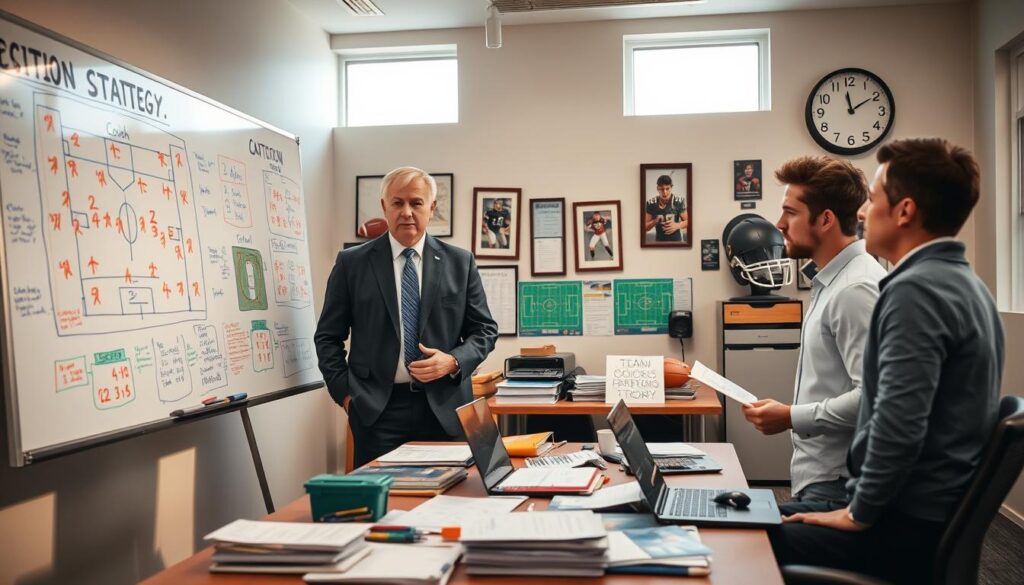
Special teams are getting a lot of attention now. Joe Houston, a Belichick protégé, is on board. This means field position will be a key factor. Expect smart punt blocks, better return decisions, and a focus on small gains that win games.
So, what does this mean for the team’s performance? The position coach updates suggest three main changes:
- A more physical, possession-oriented offense that uses tight ends as both blockers and receivers to control the clock.
- A defense that trades simplicity for deception, aiming to create negative plays and turnovers.
- Special teams that are strategically leveraged, moving from an afterthought to a tangible field-position advantage.
Last year’s schemes seemed simple. This offseason’s changes suggest a more detailed approach. The goal is to outsmart opponents, not just outmuscle them.
Recruiting/Player Development Impacts
Forget the playbook for a second; the most profound impact of Florida’s front office shuffle will be measured in stars, pounds, and dollar signs. These coaching staff announcements signal a move from a traditional college model to a hybrid NFL front-office approach. The creation of a “general manager” (Jacob LaFrance) and “director of scouting” (Joe Hamilton) isn’t just new titles—it’s a declaration. Why recruit like a college program when you can operate like the Jacksonville Jaguars?
Napier’s philosophy is now crystal clear: “draft your team” through high school recruiting, then “answer questions with free agency” via the transfer portal. It’s a two-tiered roster-building strategy that acknowledges modern college football’s realities. This approach already paid its first dividend, landing quarterback Graham Mertz. His career has had the trajectory of a rollercoaster, but in this system, he’s a targeted “free agent” acquisition meant to solve an immediate need.
The player development side gets a similar pro-level upgrade. New strength coach Craig Fitzgerald imports NFL methodologies to Gainesville, tasked with transforming players’ bodies. The program’s refined NIL strategy aims to transform their bank accounts. It’s a holistic, three-pronged attack on development:
- Skill Development: Through on-field coaching and scheme fit.
- Physical Development: Via Fitzgerald’s NFL-grade strength and conditioning program.
- Financial & Brand Development: Leveraging structured NIL opportunities for players.
This isn’t just a new playcaller or a different defensive alignment. This is a systemic overhaul of how talent is identified, acquired, and cultivated. The recruiting and player development philosophy is now a core product, sold to prospects and their families as a complete professional preparation package. You develop their skills, forge their bodies, and—critically—build their financial portfolios. In today’s landscape, that’s the sales pitch.
The long-term bet behind these coaching staff announcements is simple: sustainable success isn’t just won on Saturdays. It’s won in living rooms with a compelling development blueprint, in the weight room with proven results, and in the new economy of athlete compensation. Florida isn’t just hiring coaches; they’re building a talent factory.
Timeline & Contract Notes (Public Info Only)
Billy Napier’s work is a mix of fast and slow. He hires support staff quickly, but explaining coaching roles takes forever. This mix-up is at the heart of the coordinator changes issue.
College football’s “public info only” rule means secrets are common. Contracts are hidden, but Florida’s situation is interesting. They might have the highest-paid “executive defensive head coach” in the game. We don’t know the cost.
Napier gave a hint about his team’s changes. He said, “We’re in the process of that right as we speak.” This could mean real talks are happening, or it’s a test during spring practice. Or maybe, they’ve created so many titles they can’t keep track.
This situation creates a confusing timeline. It’s like watching a dance where some know the steps, and others wait for the music. Here’s what we can figure out.
| Role / Area | Personnel | Public Timeline / Status | Context |
|---|---|---|---|
| Support Staff & Analysts | Various (Dozen+ Hires) | Lightning-Fast (Ongoing) | Napier’s “army” is growing fast. These hires are often announced right away. |
| Major Coordinator Changes | New DC Austin Armstrong | Announced Promptly | The main coordinator changes were shared quickly. But, the contract details are secret. |
| Assistant Coach Contracts | Peterson, Juluke, Sale, Stapleton | “In the Process” (Napier) | The main mystery is the assistant coach contracts. The public is waiting for answers. |
| Role Definitions | Executive Head Coach for Defense | Glacially Slow | Explaining the new roles is taking forever. We’re all waiting to see how they work in games. |
So, what does this timeline show? Napier is building fast, but explaining the roles is slow. It’s a risky move. Fans see lots of activity but wait for the details. The coordinator changes are done, but the fine print is yet to come.
Quote Sheet: best lines from coaches and players
The most revealing insights into Florida’s football future aren’t found in playbooks. They are in the candid moments captured by a microphone. Press conferences are scripted, but a genuine quote cuts through like a laser.
Take Anthony Richardson’s self-assessment: “sometimes in the game I get too happy with my feet.” This isn’t just a player note; it’s a confession. It shows a specific scheme tendency where the quarterback’s first instinct is to scramble. For analysts, it explains missed downfield reads or a passing game that stalls when the primary option is covered.
Then there’s Billy Napier’s take on the modern landscape: “the game has become a little bit more transactional.” Calling NIL “a little bit transactional” is like calling a hurricane “a little bit breezy.” This isn’t a complaint; it’s a strategic admission. It outlines the new reality of roster construction and player retention, a philosophical shift as important as any play call.
Together, these quotes paint a vivid picture. One addresses on-field mechanics and impulse control. The other defines the off-field ecosystem. Both signal clear scheme tendencies—one for the offense on Saturday, the other for the program’s operation every other day of the week.
For fans seeking this layer of analysis, tuning into the best Gators football podcasts is essential. That’s where these soundbites get dissected beyond the headline. These quotes are more than just lines; they are the raw material for understanding the philosophical shifts that dictate future scheme tendencies and the entire Gator trajectory.
Fan FAQ: what changes immediately vs slowly
So, the question everyone is asking: when do we stop losing to Kentucky? The answer lies in separating the immediate fixes from the long-term rebuild.
Expect to see changes now. The defensive staff should look less confused and more engaged. Special teams might not be a weekly disaster. Anthony Richardson’s development timeline is the biggest variable. He either becomes Cam Newton or gets benched. The running back rotation will be clearer. These are the direct results of recent position coach updates.
Billy Napier says the offense will keep the same system. The real shifts from these position coach updates are subtle but critical. They signal a move from a reactive to a proactive scheme.
What comes slowly? The culture transformation from “transactional” to “transformational” won’t happen in a season. Building a recruiting pipeline to challenge Georgia is a multi-year project. Fans must learn patience with a process-oriented coach. Napier schedules his day with the precision of a NASA launch.
The immediate view is about wins. The long view is about championships. The new staff can fix X’s and O’s fast. Changing the entire program’s DNA takes Halley’s Comet’s return schedule. The position coach updates are the first step on a very long road.