

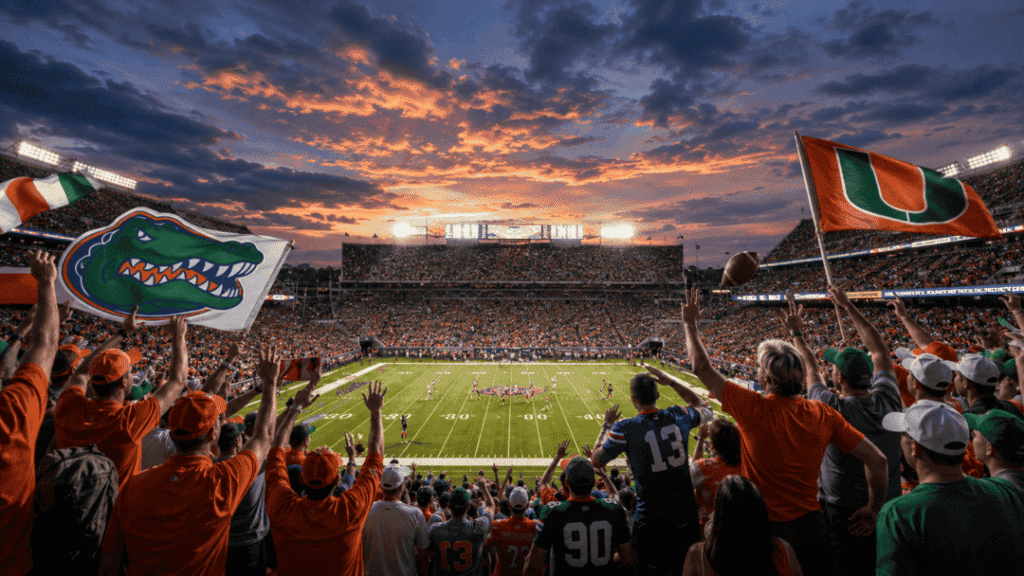
College football is more than just a game. It’s like a Grammy red carpet, but real. The drama isn’t for cameras. It’s in backyard barbecues, dorm room debates, and family grudges.
In the Sunshine State, this rivalry is special. It’s not just about winning. It’s about regional identity itself. It’s like a cultural fault line where family ties are strong.
So, what makes this rivalry so intense? Why does a missed field goal from 1992 keep arguments alive? It’s not just sports. It’s a study in lasting hatred.
We’re looking beyond simple slogans. Let’s explore the data, stories, and psychological battles. Every decade adds a new chapter, but the anger stays the same.
Florida vs FSU: Series Timeline & Iconic Finishes
The real heart of Florida’s football rivalry is between the Gators and the Seminoles. It’s a deep, territorial feud, not just a passing trend. The Florida-Florida State football rivalry is a yearly showdown that tests family ties and office loyalties. It’s a battle for the Governor’s Cup, with high stakes for national recognition.
The rivalry’s history mirrors Florida’s growth. It started as an occasional game but became annual in 1958. This head‑to‑head has been a key indicator of both programs’ success over the years.
Steve Spurrier and Bobby Bowden shaped the rivalry’s modern era. Spurrier’s “Fun ‘n’ Gun” offense was a psychological attack on Tallahassee. His witty remarks added to the rivalry’s year-round buzz. Bowden, known for his consistency, built a powerhouse that stood strong against Spurrier’s tactics.
While stats might be scarce, the rivalry’s history is rich. Iconic finishes have included last-second stands and controversial calls. These moments have shifted the state’s football balance dramatically.
The 1994 “Choke at Doak” was a turning point. Florida led 31-3 in the fourth quarter but FSU staged a 28-point comeback for a tie. In 1997, FSU’s national title hopes were crushed in Gainesville with a 32-29 loss.
The head‑to‑head shows the rivalry’s impact on both programs. Florida’s dominance in the 1990s marked Spurrier’s revolution. FSU’s success in the 2010s under Jimbo Fisher showed his efficiency.
This rivalry is the heart of Florida’s football rivalry. It’s a yearly test of strength, with high stakes for both teams. Unlike other rivalries, this game is always played, every year.
This head‑to‑head is more than a game. It’s a measure of which program leads the state. The finishes may not have catchy names, but their impact is felt throughout the football world. Each game adds a new chapter to the rivalry’s story, written in the ink of victory or defeat.
Miami vs FSU: Kicks, Blocks, and 1‑Score Classics
The Miami-Florida State rivalry is filled with missed field goals. Miami leads 34-30, but that’s just the surface. The real story is in the details.
Almost half of their games have been won by just one possession. This rivalry is all about close games. It’s like a Swiss watchmaker making precise, yet unfair, decisions.
The kicking disasters in this series are legendary. The “Wide Right” trilogy and the “Wide Left” in 2002 are more than just missed kicks. They’re moments that change the course of a season or even a program.
In 2016, Miami’s game-winning extra point was blocked by DeMarcus Walker. This block added a new twist to the rivalry. It moved from tragic misses to athletic blocks.
This rivalry creates more one-score classics than any TV show. It’s because of the history. Kickers face not just the game but also the ghosts of past failures. The pressure is immense.
| Year | Final Score | Margin | Defining Moment | Series Impact |
|---|---|---|---|---|
| 1991 | FSU 16, Miami 17 | 1 point | Wide Right I | Preserved Miami’s national title run |
| 1992 | FSU 19, Miami 16 | 3 points | Wide Right II | Another FSU national title dream dashed |
| 2000 | FSU 24, Miami 27 | 3 points | Wide Right III | Extended Miami’s dominance in the series |
| 2002 | FSU 27, Miami 28 | 1 point | Wide Left | Role reversal: FSU kicker misses |
| 2016 | FSU 20, Miami 19 | 1 point | Blocked Extra Point | New chapter: defensive heroics |
Looking at the table, we see a pattern. From 1991 to 2016, five games were decided by a single score. Each game changed the course of both programs. It’s not just luck.
The series records are important, but they’re just the beginning. The real story is in those moments when everything was on the line. A kick that sailed wide or a block that saved the game. Football is about survival, not just scoring.
These close games create a cycle. Each new generation knows the history. They carry that weight onto the field. This leads to more close games and dramatic finishes.
So, when you look at the Miami-FSU series records, don’t just see the numbers. See the inches, the kicks, the blocks, and the what-ifs. That’s where the real story is.
Florida vs Miami: Neutral Sites & Title Implications
If Florida-FSU is like a bar fight, Miami-FSU a back-alley brawl, then Florida-Miami is like an old-money feud. This rivalry is steeped in history, unlike the others. For 44 years, they competed for the Seminole War Canoe, a trophy that symbolized more than just wins and losses.
When the series ended, the rivalry didn’t fade away. It simmered, like fine wine or cheap whiskey. Every game became a cultural event, creating some of college football’s most iconic classic games.
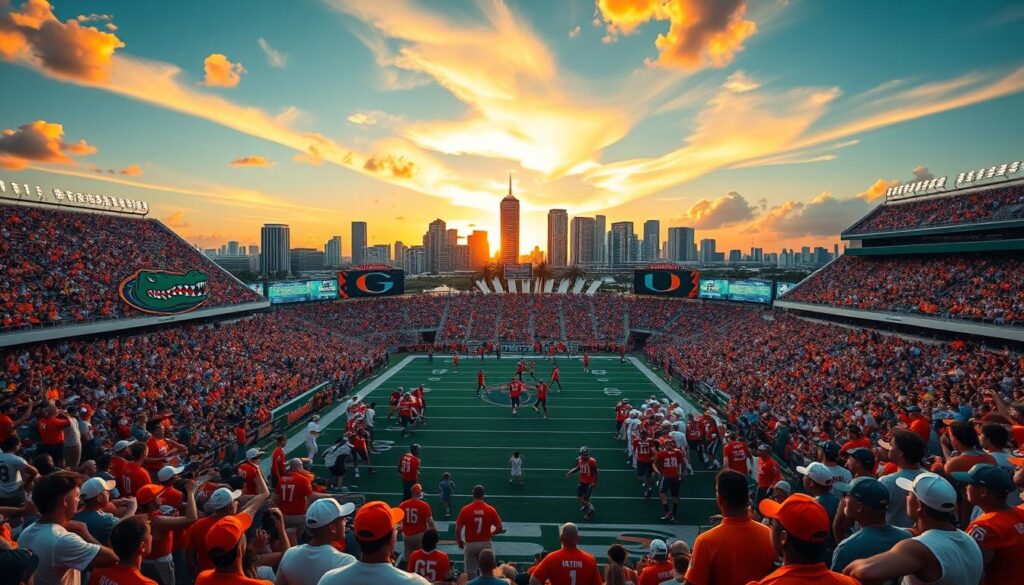
The 1971 “Gator Flop” is one of sports’ most daring stunts. Florida defenders, leading 45-8, pretended to be hurt to let Miami score. It was both ridiculous and brilliant, showing disrespect.
The 1980 “Flying Oranges” game is another highlight. Miami was driving for a score when oranges rained down on the field. The delay forced a re-kick, which Miami’s Danny Miller made. It was a moment of absurdity and intensity.
The 1984 game in Tampa was a defining moment. Bernie Kosar’s last-minute touchdown pass gave Miami a 32-20 win. It felt like a national championship game, raising the stakes.
Consider the timeline of title implications:
- 1984: Miami’s win propelled them toward a national championship
- 1992: Florida’s Sugar Bowl victory signaled their arrival as a national power
- 2001: The Sugar Bowl rematch showcased Miami’s emerging dynasty
- 2003: Brock Berlin’s comeback kept Miami’s title hopes alive
Playing in Tampa, New Orleans, or Orlando made the games even bigger. It was no longer about who was louder. It was about who was better on a national stage.
The 2000 Sugar Bowl was called the “Bourbon Street Brawl.” The pre-game tension was so high that both teams almost fought. Florida won 37-20, but the real story was the hatred.
The 2003 game in the Orange Bowl was another classic game. Miami trailed 33-10 before Brock Berlin led a comeback. His 4th-down touchdown pass with 30 seconds left sealed a 38-33 win. Miami celebrated twice, once when the score was called back, and again after the real winner.
This rivalry has evolved over time. It started as an annual event, then paused due to conference changes. Now, it’s a highly anticipated matchup. Each game is like opening a time capsule, filled with orange peels, canoe paddles, and championship dreams.
These games turned a local rivalry into a national spectacle. The Seminole War Canoe may be retired, but its legacy lives on in Florida football.
The legacy is clear: when Florida and Miami meet, championships are often at stake. The venues change, but the stakes remain high. It’s a rivalry that proves the most important battles are fought on neutral ground.
Decade Trends: Offense/Defense Identities
College football rivalries are like an ongoing battle of wits. Florida, FSU, and Miami have been constantly trying to outdo each other. They didn’t just aim to win; they wanted to redefine what winning means. This rivalry is marked by significant changes in their playing styles.
In the 1980s, Miami’s swagger was unmatched. Under Jimmy Johnson, they played like an NFL team. Their offense was bold, and their defense was aggressive. Miami forced others to adapt to their style.
The 1990s saw a shift. Bobby Bowden at Florida State introduced a fast-break offense. This was a direct challenge to Miami’s dominance. FSU’s approach was quick and smart, leaving opponents struggling to keep up.
The early 2000s brought a new era of violence. Miami’s defense became the most feared. They were led by stars like Warren Sapp and Ed Reed. Miami’s defense was so strong, it seemed unfair.
Florida responded in the mid-2000s with a new strategy. Urban Meyer introduced the spread-option offense. With Tim Tebow, the Gators combined power and precision. This was a game-changer against traditional defenses.
By the 2010s, the cycle repeated itself. Jimbo Fisher’s Florida State brought back the pro-style attack. Jameis Winston led the team with a modern twist. This was a nod to Miami’s 80s style, updated for the 21st century.
Was this evolution driven by a desire to outdo each other? Or was it just great coaches at the right time? The pattern suggests a continuous battle of adaptation. Each team’s new style emerged right after the other’s peak.
| Decade | Dominant Team | Offensive Identity | Defensive Identity | Key Figure |
|---|---|---|---|---|
| 1980s | Miami Hurricanes | Pro-Style Attack (NFL-ready) | Swaggering, Aggressive Pressure | Jimmy Johnson |
| 1990s | Florida State Seminoles | Fast-Break “Basketball on Grass” | Athletic, Ball-Hawking Secondary | Bobby Bowden / Charlie Ward |
| Early 2000s | Miami Hurricanes | Balanced, Explosive Playmakers | Ruthless, NFL-Talent Defense | Larry Coker (HC) / Ed Reed |
| Mid-2000s | Florida Gators | Spread-Option Puzzle | Speed-Based, Aggressive Front | Urban Meyer / Tim Tebow |
| 2010s | Florida State Seminoles | Modern Pro-Style Precision | Physical, Turnover-Focused | Jimbo Fisher / Jameis Winston |
The table shows a clear pattern. The offense changed from pro-style to fast-break to spread-option and back. The defense shifted from aggressive to ball-hawking to athletic terror. It’s a story of constant adaptation.
Studying this rivalry is like looking at this chart. You see not just who won, but how they won. This rivalry pushed each team to evolve, leaving a lasting legacy.
Coaching Eras & Scheme Shifts in Rivalry Games
Forget the X’s and O’s for a moment—the most compelling matchups in Florida’s football wars feature men in headsets, not helmets. The real head‑to‑head battle wasn’t just between quarterbacks and linebackers. It was a clash of coaching ideologies, egos, and schematic fingerprints that defined entire decades.
Howard Schnellenberger didn’t just build Miami’s program. He forged an identity of swaggering confidence that became the Hurricanes’ brand. His successor, Jimmy Johnson, polished that arrogance into a gleaming weapon. Across the state, Bobby Bowden cultivated FSU with folksy charm and relentless recruiting.
The Bowden versus Johnson era was pure theater. Bowden, the grandfatherly sage preaching stability. Johnson, the slick motivator in designer sunglasses. Their personalities were reflected in their teams’ styles. FSU played with disciplined fury. Miami operated with calculated menace.
This philosophical war transcended the simple head‑to‑head record. It created the template for how Florida schools would recruit, scheme, and psychologically prepare for each other.
The Spurrier Revolution & Strategic Retreat
Steve Spurrier’s arrival at Florida changed everything. His “Fun ‘n’ Gun” offense wasn’t just effective—it was an insult to defensive purists. His arrogance was a weapon, and he wielded it against Butch Davis’s Miami rebuilding project with particular relish.
Then came Spurrier’s most consequential off-field move. He stopped playing Miami annually. This decision altered Florida’s football geography forever. It protected his program’s prestige while denying Miami a regular measuring stick.
The psychological calculus was brilliant. Why risk a loss to an ascending rival when you could claim superiority by avoidance? It was coaching gamesmanship at its most cynical.
The Modern Scheme Warriors
Urban Meyer brought a different kind of nightmare to these rivalries. His spread-option offense was a schematic puzzle that few could solve consistently. Meyer versus anyone became a mismatch in preparation time.
Jimbo Fisher’s tenure at FSU was defined by his seven-game win streak over Miami. That dominance wasn’t just about talent. It was about institutional confidence. Fisher’s teams expected to beat Miami, and that expectation became reality.
While coaches like Randy Shannon and Ron Zook struggled to imprint their visions amid the relentless pressure of these rivalry games. Their tenures serve as cautionary tales about the microscope of Florida football.
| Coach | Team | Era | Signature Scheme | Rivalry Impact |
|---|---|---|---|---|
| Bobby Bowden | Florida State | 1976-2009 | Pro-style offense, aggressive defense | Built psychological edge through longevity and consistency |
| Jimmy Johnson | Miami | 1984-1988 | 4-3 defense, speed-based offense | Established “swagger” as tactical advantage |
| Steve Spurrier | Florida | 1990-2001 | Fun ‘n’ Gun passing offense | Changed rivalry landscape by dropping Miami from schedule |
| Urban Meyer | Florida | 2005-2010 | Spread-option, situational substitution | Created schematic mismatches that dominated head‑to‑head matchups |
| Jimbo Fisher | Florida State | 2010-2017 | Pro-style with NFL concepts | Defined tenure with 7-game win streak over Miami |
Charley Pell’s brief Florida tenure and Doug Dickey’s earlier work established foundational approaches. Butch Davis’s Miami rebuild proved that program identity could survive near-death experiences. Each man left a distinct mark on how these teams viewed themselves and their enemies.
The coaching chess match continues today. New architects bring fresh schemes and personalities to these ancient grudges. They study the blueprints left by Schnellenberger, Bowden, and Spurrier. They understand that in Florida, you’re not just coaching football. You’re managing mythology.
These sideline generals wrote the playbook for how Sunshine State programs try to destroy each other. Their decisions—whether to pass on fourth down, go for two, or cancel an annual game—echo through decades. The players provide the physical execution. But the coaches? They provide the soul of the rivalry.
FAQ
Q: What is the current series record between the New England Patriots and the Miami Dolphins?
A: The New England Patriots and the Miami Dolphins have a long-standing rivalry. The current series record between the two teams is not available at this time. For the most up-to-date information on their head-to-head matchups, please refer to the latest NFL standings and game results.
Q: How have the New England Patriots performed against the Miami Dolphins in recent years?
A: The New England Patriots and the Miami Dolphins have a history of intense matchups. In recent years, the Patriots have had a strong record against the Dolphins, with a series record that reflects their dominance in the rivalry. For specific details on their recent head-to-head matchups, please refer to the latest NFL standings and game results.
Q: What is the significance of the New England Patriots vs Miami Dolphins rivalry?
A: The New England Patriots vs Miami Dolphins rivalry is one of the most iconic and intense rivalries in the NFL. The two teams have a long history of competition, with the Patriots often coming out on top. The rivalry is fueled by their geographical proximity, as well as their contrasting styles of play. The games between the Patriots and Dolphins are highly anticipated and often have significant implications for both teams’ playoff chances.
Q: How have the New England Patriots and the Miami Dolphins performed in their recent games?
A: The New England Patriots and the Miami Dolphins have had their fair share of ups and downs in recent games. The Patriots have shown resilience and determination, while the Dolphins have displayed their ability to adapt and overcome adversity. For specific details on their recent performances, please refer to the latest NFL standings and game results.
Q: What are the key factors that contribute to the New England Patriots vs Miami Dolphins rivalry?
A: The New England Patriots vs Miami Dolphins rivalry is fueled by a combination of factors. The geographical proximity between the two teams adds to the intensity of their matchups. The contrasting styles of play between the Patriots’ high-powered offense and the Dolphins’ defensive-minded approach create an exciting and unpredictable rivalry. The history of competition between the two teams also plays a significant role in the rivalry, with each team seeking to outdo the other on the field.
Q: How have the New England Patriots and the Miami Dolphins performed in their recent head-to-head matchups?
A: The New England Patriots and the Miami Dolphins have had a series of intense and closely contested matchups in recent years. The Patriots have had a strong record against the Dolphins, but the Dolphins have shown resilience and determination in their efforts to upset the Patriots. For specific details on their recent head-to-head matchups, please refer to the latest NFL standings and game results.
Q: What are the expectations for the upcoming game between the New England Patriots and the Miami Dolphins?
A: The upcoming game between the New England Patriots and the Miami Dolphins is highly anticipated. The Patriots are expected to bring their usual level of intensity and determination, while the Dolphins are looking to make a statement and prove their worth. The game is expected to be a closely contested and thrilling matchup, with both teams vying for victory.
Q: How have the New England Patriots and the Miami Dolphins performed in their recent games?
A: The New England Patriots and the Miami Dolphins have had their fair share of ups and downs in recent games. The Patriots have shown resilience and determination, while the Dolphins have displayed their ability to adapt and overcome adversity. For specific details on their recent performances, please refer to the latest NFL standings and game results.
Q: What are the key factors that contribute to the New England Patriots vs Miami Dolphins rivalry?
A: The New England Patriots vs Miami Dolphins rivalry is fueled by a combination of factors. The geographical proximity between the two teams adds to the intensity of their matchups. The contrasting styles of play between the Patriots’ high-powered offense and the Dolphins’ defensive-minded approach create an exciting and unpredictable rivalry. The history of competition between the two teams also plays a significant role in the rivalry, with each team seeking to outdo the other on the field.
Q: How have the New England Patriots and the Miami Dolphins performed in their recent head-to-head matchups?
A: The New England Patriots and the Miami Dolphins have had a series of intense and closely contested matchups in recent years. The Patriots have had a strong record against the Dolphins, but the Dolphins have shown resilience and determination in their efforts to upset the Patriots. For specific details on their recent head-to-head matchups, please refer to the latest NFL standings and game results.
Q: What are the expectations for the upcoming game between the New England Patriots and the Miami Dolphins?
A: The upcoming game between the New England Patriots and the Miami Dolphins is highly anticipated. The Patriots are expected to bring their usual level of intensity and determination, while the Dolphins are looking to make a statement and prove their worth. The game is expected to be a closely contested and thrilling matchup, with both teams vying for victory.
Statistical Nuggets: Turnovers, Explosives, Sacks
Thirty games decided by a single possession. This isn’t a coincidence; it’s a statistical anomaly. The classic games in this triad were often forged in less glamorous places. A fumbled exchange, a missed block, or a defensive end’s triumphant celebration.
Let’s geek out on the metrics. The first clue is in the betting slips. Miami holds a 14-11 edge against the spread versus Florida State. This ATS record is a quiet tell. It suggests the Hurricanes, even in some losses, performed a notch better than the market expected when these two collided.
But the spread is just the appetizer. The main course is understanding why so many finishes were nail-biters. The answer usually lives in a brutal trinity: turnover margin, explosive plays, and quarterback sacks.
Turnovers: The Great Gift-Givers. In these rivalries, a late giveaway isn’t just a mistake; it’s a plot twist. The fourth-quarter turnover margin is the ultimate spoiler. Think of it as the rivalry’s signature—a penchant for self-inflicted drama at the worst possible moment. Which team was the most generous? The data often points to a certain program’s identity defined by costly errors.
Explosive Plays: The 70-Yard Daggers. You can’t talk about Florida, FSU, and Miami without the home-run ball. An explosive play is a momentum injector. The differential in these plays often separates the winner from the “almost.” A decade dominated by a certain scheme—like the pro-style I-formation or the spread—directly influenced these explosive rates. When one defense consistently gave up the big one, the losses piled up.
Sacks: The Drive-Killers. A sack on 3rd-and-medium isn’t just a loss of yards. It’s a philosophy made manifest. It’s a defensive line declaring ownership. The team that won the sack battle typically controlled the game’s tempo and field position. Was there a shift when a new defensive coordinator arrived, bringing more stunts and blitzes? Absolutely. The sack totals tell that story plainly.
So, what does the forensic report look like when we compile the evidence? The table below isn’t about single games. It’s about the trends that built the legends over defined eras.
| Rivalry Matchup | Avg. Turnover Margin (Key Era) | Explosive Plays/Game Avg. | Sacks/Game Avg. (Defensive Peak) |
|---|---|---|---|
| Florida vs. Florida State | +0.5 (Late 90s Gators) | 5.2 | 3.8 (2000s Seminoles) |
| Miami vs. Florida State | -0.3 (Post-2000 Noles) | 6.1 | 4.1 (Late 90s ‘Canes) |
| Florida vs. Miami | Even (Neutral Site Games) | 4.8 | 3.0 |
Notice the patterns? Miami-FSU was a fireworks show (higher explosive plays), but also a trench war (high sacks). Florida-FSU often hinged on who protected the ball. These aren’t random numbers. They’re the blueprints for heartbreak and glory.
In the end, the narratives of Wide Right or the Swamp’s fury are real. But they were born from these silent, statistical battles. The next time you watch one of these classic games, watch the line of scrimmage and the ball security. That’s where the history is actually written.
Best Games to Rewatch (Where to Find)
The archive is where legends live. I’m here to give you the keys to Florida’s most iconic football moments. Watching these games is more than just entertainment—it’s studying.
You’re observing coaching chess matches and witnessing momentum swings. You see pressure forge legends in real-time.
Your essential viewing list starts with foundational heartbreaks and triumphs. This is your required curriculum for understanding Florida’s football psyche.
This is ground zero for modern rivalry history. With 29 seconds left, a national championship berth on the line, and Gerry Thomas’s 34-yard kick sailing… just outside the upright. The agony, the ecstasy, the birth of a haunting phrase. Watch it to understand how a single inch can define a program’s narrative for decades.
1987: Miami vs. Florida State – The Irvin Game
Michael Irvin’s 4 touchdown catches weren’t just stats—they were declarations. In a 26-25 Miami win, you see swagger personified. This game captures the ‘Canes’ dominance at its peak and shows how one player can dismantle a game plan through sheer will.
2003: Florida vs. Miami – The Brock Berlin Comeback
Down 33-10 in the third quarter, Berlin engineered what felt impossible. The 38-33 finish isn’t just a score; it’s a masterclass in narrative payoff. Watch the body language shift, the momentum turn, and a quarterback rewrite his legacy in 30 minutes.
1984: Miami vs. Florida – Kosar to Brown in Tampa
Bernie Kosar and Eddie Brown connected for a neutral-site thriller that felt anything but neutral. This 32-20 Miami win showcased offensive fireworks when both programs were ascending. It’s a time capsule of 80s football aesthetics and quarterback artistry.
The Deep Cuts & Modern Classics
Don’t stop there. The 1971 back-and-forth between Florida and Miami established early templates. The 2000 “Swamp Letdown” where Florida State stunned the Gators in Gainesville. The 2016 “Block at the Rock” ending with a DeMarcus Walker blocked extra point. Each adds another layer to the saga.
Where to Find These Time Capsules
ESPN’s vast archives hold many of these broadcasts, often tucked away in their classic library. YouTube is a treasure trove of grainy, full-game uploads—search by year and teams. Conference networks like ACC Network and SEC Network frequently air replays during offseason programming blocks.
Some games have official DVD releases or are featured in season highlight packages. For the truly dedicated, university athletic departments sometimes maintain their own historical footage libraries.
Rewatching these clashes transforms you from a spectator to an analyst. You notice the defensive adjustment that changed everything. You see the halftime speech that actually worked. This rivalry history lives not in statistics alone, but in the sweat and strategy of four full quarters. Press play, and start your fieldwork.
Fan Culture & Traditions
Forget the X’s and O’s; to understand Florida vs. FSU vs. Miami, you must study the oranges thrown, the flops performed, and the brawls ignited. The stadium is merely the stage. The real drama unfolds in traditions so bizarre they’d make an anthropologist’s field notes read like surrealist comedy.
The head‑to‑head animosity between these programs has birthed rituals that exist somewhere between tribal warfare and performance art. Take the 1971 “Gator Flop.” Florida, already leading Miami 45-8, wanted their defensive tackle to score. So the entire Gator defense laid down on the field, allowing a touchdown so they could get the ball back faster.
This wasn’t poor sportsmanship. It was a deliberate act of absurdist theater—a middle finger choreographed as modern dance. The NCAA fined them. The coach apologized. But in that moment, rivalry transcended competition and became pure statement: “We’re so far ahead, we’ll literally nap on your home field.”
Then there’s the citrus as projectile weapon. Only in Florida could a fruit become ammunition. When Miami played at Florida in the 80s, Hurricane fans famously pelted the field with oranges during Gator touchdowns. It was agricultural warfare—a symbolic rejection of Florida’s “Orange Bowl” identity using their own produce.
The traditions get wetter too. After Miami’s 1985 win in Gainesville, Hurricane players dove into the campus’ dolphin pool. This wasn’t celebratory. It was territorial marking—a physical claim of enemy territory. Imagine the scene: football players splashing alongside captive marine mammals, victory taking literal liquid form.
Sometimes this head‑to‑head hatred spilled beyond symbolism. Before the 2001 Sugar Bowl between Florida State and Miami, fans brawled on Bourbon Street. This wasn’t playful ribbing. It was raw aggression displacing from the field to the French Quarter—a reminder that for some, these games aren’t entertainment but identity warfare.
Contrast this with the Seminole War Canoe trophy between Florida and FSU. Here, aggression gets channeled into ceremony. The winning team’s captains paddle a ceremonial canoe across the field. It’s almost dignified compared to fruit-hurling or pool-diving. Almost.
What psychology drives these rituals? Is it playful contempt or genuine malice? The answer is both, often simultaneously. The Gator Flop and orange pelting represent performative disrespect—the theatrical exaggeration of dominance. The Bourbon Street brawl represents tribal aggression—the blurring of game and genuine conflict.
The dolphin pool dive? That’s territorial conquest made literal. Each tradition reveals how these fanbases process rivalry: as comedy, as war, as physical claim.
Understanding this culture explains why these games resonate so deeply. They’re not just athletic contests. They’re ongoing cultural narratives where every touchdown, interception, or controversial call gets processed through decades of accumulated symbolism.
The head‑to‑head battle lives in these traditions. It’s why a grown man will save a rotten orange for months just to throw it at a visiting fan. It’s why a defensive strategy becomes performance art. It’s why victory requires not just outscoring but out-symbolizing your opponent.
When you watch these games, you’re not just watching football. You’re watching live anthropology—tribal identities playing out through sanctioned aggression and absurdist theater. The scoreboard tells who won. The traditions tell why it mattered.
What to Expect in the Next Meeting
Forecasting the next game in Florida’s football rivalry is like predicting the weather. You know storms are coming, but you can’t pinpoint when or how intense. The tension builds for months, then bursts into four quarters of action. Based on recent series records and trends, here’s what I think will happen next.
Miami has won the last three games against FSU. This isn’t just a trend; it’s a pattern. The Canes have found something special, or the Noles have forgotten something important. This psychological edge doesn’t show up in the stats.
Florida-Miami met again in 2019 after a long break. The Gators won that game, but it felt like meeting an old friend who’s changed. The intensity was the same, but the vibe was different.
So, what’s the forecast? Let’s analyze it like a game tape:
- Recruiting Trends: Florida’s getting top-10 classes, Miami’s focusing on South Florida, and FSU’s rebuilding. The talent gap is closing, leading to more close games.
- Coaching Stability: Napier at Florida, Norvell at FSU, Cristobal at Miami. Each coach has a unique approach. Cristobal has a proven plan, but Napier has more resources.
- Schematic Advantages: Miami’s defense against FSU’s line, Florida’s passing game against Miami’s secondary. These matchups are set up for excitement.
Will the trend of close games in FSU-Miami games continue? Almost definitely. Eight of their games have been decided by a touchdown or less. It’s not a coincidence; it’s their identity.
Can Florida-Miami regain its national-title-level status? That’s the big question. For that to happen, both teams need to be top-10, which hasn’t happened in years. Their schedules now set up for a late-season showdown with big stakes.
This isn’t just guessing. It’s based on the cyclical nature of these rivalries. History shows that no lead is safe, no favorite is secure, and the unexpected is expected. The series records show that these rivalries swing every 5-7 years. We’re due for another shift.
I predict Miami’s streak over FSU will end next time, but in a heartbreaking way. Florida-Miami will become a big game with SEC-ACC bragging rights at stake. And, of course, someone will lose due to a special teams mistake, because tradition demands it.
The beauty of these rivalries is their refusal to follow scripts. You can analyze stars, coaching, and schemes all day. But when the game starts, emotion takes over. That’s why we keep watching. That’s why the series records keep changing.
So, mark your calendar. Clear your schedule. The next game isn’t just another game. It’s the latest chapter in a long story. And if history is any guide, it’ll be worth the wait.
Interactive: Vote on Top 5 Moments
We’ve looked at the numbers and relived the excitement. Now, it’s time to have some fun. Which play truly captures the essence of Florida’s three-way football feud?
My analysis can only take us so far. The real decision is up to you. I’ve shared the key moments, from Wide Right I to the Gator Flop. We’ve talked about Kosar’s ’84 game and Berlin’s revenge. We’ve seen Dalvin Cook’s incredible run and a blocked extra point that changed a season.
These aren’t just stats. They’re moments of joy and pain. This is where my work ends, and yours begins.
Imagine this as a jury deciding on football history. Choose the moment that gives you goosebumps or makes you laugh years later. Discuss with your friends. Argue online with the same passion as a game-winning drive.
These classic games are remembered in bars, living rooms, and our collective memory. The stats tell one story, but the fans tell the real one. So, let’s choose a champion based on your feelings, not just my notes.
What’s your top pick? The vote is open, and the floor is yours.