
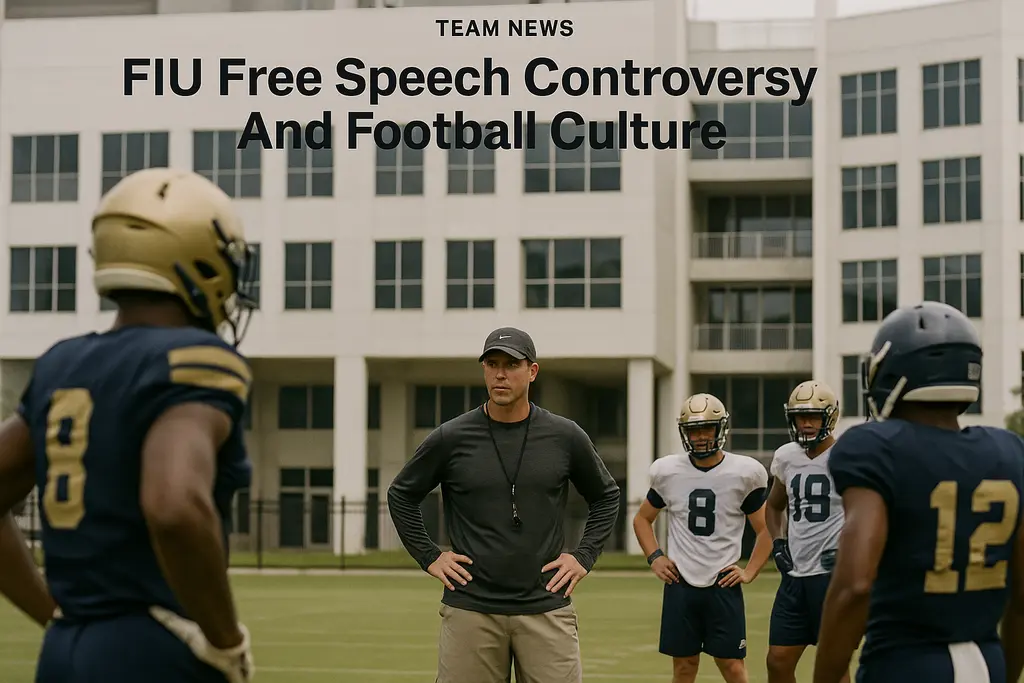
The FIU Free Speech Controversy has crossed into a space that Florida football readers will recognize: campus culture. The verified record so far centers on student discipline after a protest, not on coaches, players, roster status or team operations. That distinction matters for anyone trying to connect a university-wide debate to FIU football.
Florida International University is not just an academic institution in Miami. It is also home to a football program, student sections, alumni events, recruiting visits and game-day traditions. When a campus dispute draws public attention, it can become part of the wider environment that student-athletes live in, even if there is no proven effect on practice, competition or locker-room operations.
The available facts require a narrow read. There is no verified evidence in the research record that FIU football players participated in the March 2026 protest, were disciplined in connection with it, changed team activities because of it, or received any football-specific guidance tied to the case. The football angle is limited to what the controversy may mean for campus climate around a Division I program, not to any confirmed team development.
FIU Free Speech Controversy: What Is Verified
The March 2026 Protest
In March 2026, seven FIU students held a silent protest during a campus event featuring President Jeanette Nuñez and former MLB player Alex Rodriguez. According to WLRN, the students wore shirts reading "ICE OFF FIU" and exited after a few minutes during the event WLRN report.
That fact pattern is central because the protest, as described in the research, was not a football protest, an athletics protest or an event tied to FIU’s football schedule. It took place during a campus event involving university leadership and a public figure with a professional baseball background. Any sports discussion has to start there: this was a university governance and expression issue before it was anything else.
The Discipline At Issue
FIU charged the students with violating a policy that prohibits expressive activities inside university buildings. Inside Higher Ed reported that the students were required to submit recorded reflection videos explaining how they violated the policy and how they would comply in the future Inside Higher Ed account.
The same report stated that FIU defended its rule as consistent with First Amendment principles and said it applies the indoor-demonstration restriction uniformly to protect academic spaces from disruption. Critics, according to the research supplied for this story, viewed the video requirement as a compelled-speech concern and argued that the policy was too broad.
For football readers, the key issue is not whether a coaching staff has changed anything. There is no verified record showing that. The issue is whether a public campus dispute over expression can shape the tone around student life, which includes athletes who attend class, live on or near campus, take part in team events and represent the school in public.
Why The Football Program Is Part Of The Campus Context
Student-Athletes Share The Same Campus Space
College football programs operate inside larger university systems. Players are not separate from the student body. They attend classes, use campus facilities, interact with classmates and live under university rules. That is why a campus speech dispute can be relevant to football culture without producing a direct football transaction.
That relevance has limits. A team-news story should not imply a roster issue where none has been verified. It should not assume player reaction, staff reaction or recruiting impact without a public record. The research for this article does not show comments from FIU football coaches, football student-athletes, athletic department officials or Conference USA officials about the protest discipline.
Still, football culture is shaped by more than Saturday results. It is shaped by trust in institutions, peer conversation, student turnout, family comfort on campus and the way athletes understand their public voice. Those factors can affect the feel around a program even when they do not appear on a depth chart.
Recruiting And Campus Visits Require Careful Language
Recruiting is often where campus issues get pulled into football conversations. Prospects and families may ask about student life, safety, university rules and the way administrators handle public disputes. That does not mean the FIU case has affected recruiting. The research record does not support that claim.
A careful football read is simpler: this is a campus issue that could become part of broader questions about the student experience. If a prospect, parent or high school coach asks about the matter, FIU would likely have to explain the university policy and the disciplinary process as a campus matter, not as a football matter. No verified source in the research shows that such conversations have taken place with recruits.
For local high school football readers in South Florida, the distinction matters. FIU recruits in a region where players, families and coaches often weigh proximity, academics, coaching fit and campus comfort. A public controversy can enter casual conversation around a school, but reported facts do not establish any measurable effect on FIU’s roster pipeline.
What Is Not Supported By The Record

No Verified Link To Team Operations
The research does not show a direct link between the protest discipline and FIU football operations. There are no verified reports of canceled practices, altered team meetings, player discipline, coaching changes, game-day changes, eligibility issues or athletic department sanctions tied to the protest case.
That absence is not a small detail. In college football coverage, unsupported assumptions can travel fast. A campus controversy can sound close to a team because the team wears the university name, but the standard for team news is higher. A fact must connect to the program before it becomes a football development.
At this stage, the proper framing is that FIU is dealing with a university speech controversy while its football program exists within the same campus community. Anything stronger would require public statements, records or reporting that are not present in the supplied research.
No Verified Student-Athlete Involvement
The research does not identify any FIU football player among the seven students involved in the silent protest. It also does not identify any student-athlete in the disciplinary process described in the cited reporting. Without that, the story should not be written as an athlete discipline case.
That point protects both accuracy and the student-athletes. Players should not be linked to a disciplinary matter unless records support it. The same applies to coaches and staff. No verified fact in the research ties the FIU football locker room to the protest, the policy dispute or the reflection-video requirement.
The case may still matter to athletes as students. A quarterback, lineman, manager, trainer or walk-on could have personal views about campus speech rules, just as any student could. But no such views are documented in the research, and they should not be assigned to the team by assumption.
- Verified: Seven FIU students held a silent protest in March 2026 during a campus event.
- Verified: FIU disciplined those students under an indoor expressive-activities policy.
- Verified: The required reflection videos drew compelled-speech concerns from critics.
- Not verified: Any direct effect on FIU football practice, roster management, recruiting or game-day operations.
What This Means For FIU Football Culture
The Practical Football Read
For now, this is a campus climate story adjacent to football, not a football operations story. That is the most accurate read for FIU fans, alumni and local high school coaches following the program. It may be discussed around campus. It may be noticed by families who track university news. It may shape broader perception of the school’s approach to student expression. But none of that equals a confirmed team impact.
Football culture depends on shared identity. Student sections, alumni gatherings, tailgates and home games work best when the campus feels connected. Public disputes over speech and discipline can test that connection because they raise questions about how students are heard and how rules are enforced. Those questions reach the same student body that fills seats and supports teams.
The FIU Free Speech Controversy should be watched through that lens. If football players, coaches, the athletic department or university officials make public comments tied to athletics, that would create a new team-news development. If game-day policies, student-section access or athlete conduct rules change in response, that would also be news. The current record does not show those steps.
What To Monitor Around The Program
The most relevant items for football coverage are specific and verifiable. Reporters should monitor whether FIU athletics issues any statement, whether student-athletes are publicly identified in related proceedings, whether the football schedule or fan policies are affected, and whether university rules for indoor expression are clarified in a way that touches athletics facilities.
Until then, the story sits in a defined lane: a university free speech dispute with indirect importance to campus culture. For FIU football, the responsible approach is to separate confirmed facts from possible perception. The Panthers’ football community is part of the university, but no evidence in the available research shows that the controversy has changed how the team prepares, competes or builds its roster.